
Continuing the discussion: Where is the Big Value of Applying TOC?

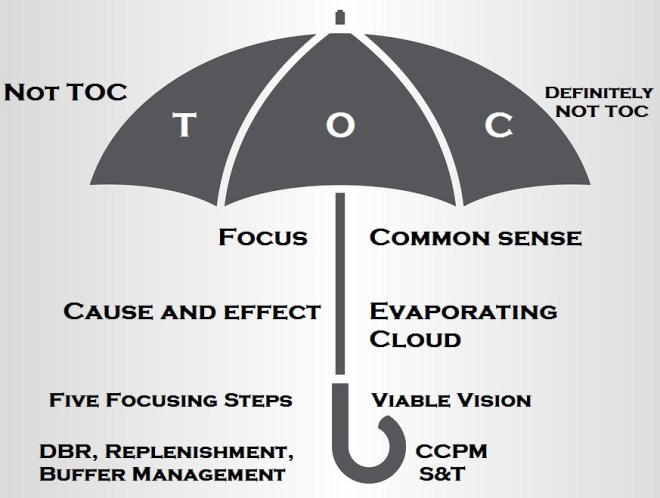
Umbrella icon

James Powell and Kevin Kohls conducted an interesting discussion about marketing TOC and the way for success. I like to follow up and make some generic observations and conclusions from my perspective.

Every TOC consultant has the goal of making more money now and in the future. In order to achieve as much of the goal the use of at least some of the TOC techniques could be beneficial.  If TOC as a brand name for a superior effective managerial approach is very strong then the consultant would include TOC in his own marketing and sales efforts.  Thus, the reputation of TOC could be a major marketing vehicle, but not every time and not for all consultants.  This is because when the competitors also use TOC as a brand name then maybe some other aspects of the offering become more dominant.

What we all miss here?

I think that we miss the big promise for HUGE value. In my original post I wrote a common belief (no hard proof yet) that all TOC practitioners have:

TOC has the potential to bring HUGE value to the vast majority of the organizations

If this is true then TOC can do much more than fix the current core problem and achieve many desired-effects. TOC is able to guide the managerial thinking to ongoing growing success, while keeping the organization from trouble.  If this is true, and if we find a reliable way to achieve and prove it, the personal goal of the TOC consultants would go up, no matter how good it already is.  In such a case, the TOC consultant would gain a real decisive competitive edge.  When an organization, or an individual (a consultant or a lawyer), has a decisive competitive edge it does not mean that there is no competition. It means that the competition does not truly diminish the results!

What many successful consultants do is to establish themselves within a niche. There are two meanings to that niche. One is the group of organizations the consultant feels he knows well the cause-and-effect and has already a certain reputation with them.  The other is that within this group of potential clients the consultant offers a certain mix of services that give good value for that group.

For instance, several key TOC consulting firms focus on medium and large retail chains, and within the retail chain they considerably improve the availability and also keeping excellent control on the assortments to ensure effectiveness.  This is certainly yielding excellent value.

But, within Retail there are other areas that could be vastly improved. Many times the availability and assortment control are, at the time, the core problem.  Sometimes (not every time) improving those aspects create a certain decisive-competitive-edge for the retail chain, even though without advertising the superior availability I suspect the value to the customer would take very long time, and most TOC consultants do not go into the advertising campaigns of the retailers.  Advertising, the definition of the specific market segments, the choice of products to display, the placing of the assortments within the store and the human relationships with the agents are just sporadic examples of areas that need to be part of the overall Strategy – if we truly mean to give HUGE value.

No person can be expert in everything. I watched Eli Goldratt very closely how he reacted to a new environment.  As Goldratt was unbelievingly brilliant he could see signals and drew the cause and effects very fast.  Many times he was right on.  Many times he was mistaken, but I’ve realized it only later because of his extraordinary charisma people tended to agree with him, even when they did not.

How can we compensate ourselves for being not as brilliant and not experts in ALL areas?

By being confident enough to ask questions and judge the quality and relevancy of the answers, and by being able to collaborate with others that have somewhat different experience and knowledge and again be able to judge the quality of the answers by the use of cause-and-effect logic.

My suggestion aims at the ambitious target of establishing TOC, all over the world, as an international, holistic and powerful managerial approach that brings HUGE value to any organization.  The key idea is collaboration between experienced people, from various geographical locations, who have wide and varied experience and share the passion to make it happen.

Should the consortium be not-for-profit? How should (or not) the consortium recommend consultants? How should the communications between local consultants and more than one experienced-international-TOC-consultant be effective from a distance?  These are part of the issues to be analyzed and agreed upon.  Certainly a group of experienced TOC experts can come to an agreement how to start working and be flexible enough to introduce changes when reality shows it is necessary.
Discussing the Direction for Marketing the Value of TOC

My last post has stirred a lot of responses, which makes me optimistic as many people care and wish to improve what we have already achieved.

I’m going to layout a certain idea as an initial direction. I also include a similar, yet different, solution by Kevil Kohls, with whom I have exchanged mails on top of the exchange of comments in the blog.

Leo Lauramaa challenged the hidden assumption that “TOC is for everyone”. Let me simply state that I believe (when I cannot logically prove I use the term ‘believe’) that the assumption is valid.  TOC uses rational tools, based on logic and common sense observations, but TOC still recognizes emotions and intuition.  I see TOC as a general managerial approach that should stretch out to other methods, like Lean and Agile, which bring good value, and analyze them to decide when they are effective and what should be challenged.  I assume managers in medium and large companies are capable to deal with rational arguments.

Some basic assumptions of mine are important for the direction I propose:

  • Competition between TOC consultants is good!
    • The Client gets a choice with whom to work on, and TOC becomes legitimate and widely recognized.
    • The main competition is with the current common approach of dissecting the organization into smaller parts pretending they are independent.


  • The real value of TOC is leading the organizations to become ever-flourishing. This holistic approach means planning the appropriate Strategy ensuring every part of the organization is aware what to do and when to do.
    • Value can be generated also by partial implementation. I understand the opinion that starting with partial implementation could, sometimes, lead to the holistic one. I think that starting with the global vision has much better chance, but this is part of the individual strategy of every consultant and practitioner.
  • The core difficulty to market TOC is that “it looks too good to be true”, as mentioned by Kevin Fox, and this causes a considerable fear. We need to learn how to overcome personal fears of people we have to convince. People overcome fear when they realize many others have successfully tried it.

Many of the responses, for instance by Kevin Fox and Henry Camp, claim that more big successes becoming known would open the way for TOC.  We also need the successes to be sustainable for long time. We better remember that the big competitors of TOC also declare successes and that it is not trivial to prove a sustainable success.  Eventually we need to convince through successes and also through the logic of the insights that applying them have to bring huge value.

The first obstacle for success is gaining access to top management of organizations to make them listen. This could be the result of effective marketing based on the chance of hearing something promising for just small amount of attention.

The next obstacle is convincing management of the huge value in applying TOC holistically. There are two obstacles to achieve that: showing them that TOC can, specifically, help them succeed in a big way, and vastly reduce their fears. This mission is definitely sales, but it has to be properly backed-up by marketing messages and preparation, taking into account the characteristics of the organization and what could be the decisive-competitive-edge (DCE) for such an organization.

The third obstacle is making sure the implementation is successful.  This is where the TOC knowledge and experience are required plus the personal capabilities of the TOC expert leading the implementation.  In order to sustain the success beyond the intervention of the TOC expert the management needs to be educated in TOC.  Succeeding to achieve that enhances the chance of getting more organization listening.

How can we overcome the above obstacles?

My direction of solution is to gather a group of top TOC experts, call it The TOC Consortium, to support high variety of TOC implementations, by giving the projects the power of international reputation, giving high level advice on critical issues, possibly facilitating the S&T and carry audits to identify obstacles and negative branches and guiding to overcome them.

The consortium would not push certain consultants over others and it could be part of competing offers to the same organization.

Goldratt initiated a series of seminars leading to two-hour meetings with the management of the interested companies. I think the idea can be still implemented. For the two-hour meeting a highly experienced TOC person is required.  I also recommend that the level of promise would be high, but not close to the unbelievable target set by Goldratt – getting net profit equals to the current turnover in four years.

Most of the support should be delivered from a distance given mainly to the local TOC experts. From time-to-time it is possible to send one of the top consultants to the specific location to help with the S&T, auditing or solving a critical issue. The point is to provide support not to take over the implementation.

This direction involves close relationships between the people in the implementation and the consultants of the consortium. These are business relationships, based on win-win-win, the client, the local TOC people and the international consultants.  The value is to create the right image of knowledge and experience, and also to actually use both in the implementation to guaranty success.

The missing element is how the TOC education is handled.  I hope that either TOCICO would be able to step in, or another international consortium is built to educate from a distance at an affordable price.

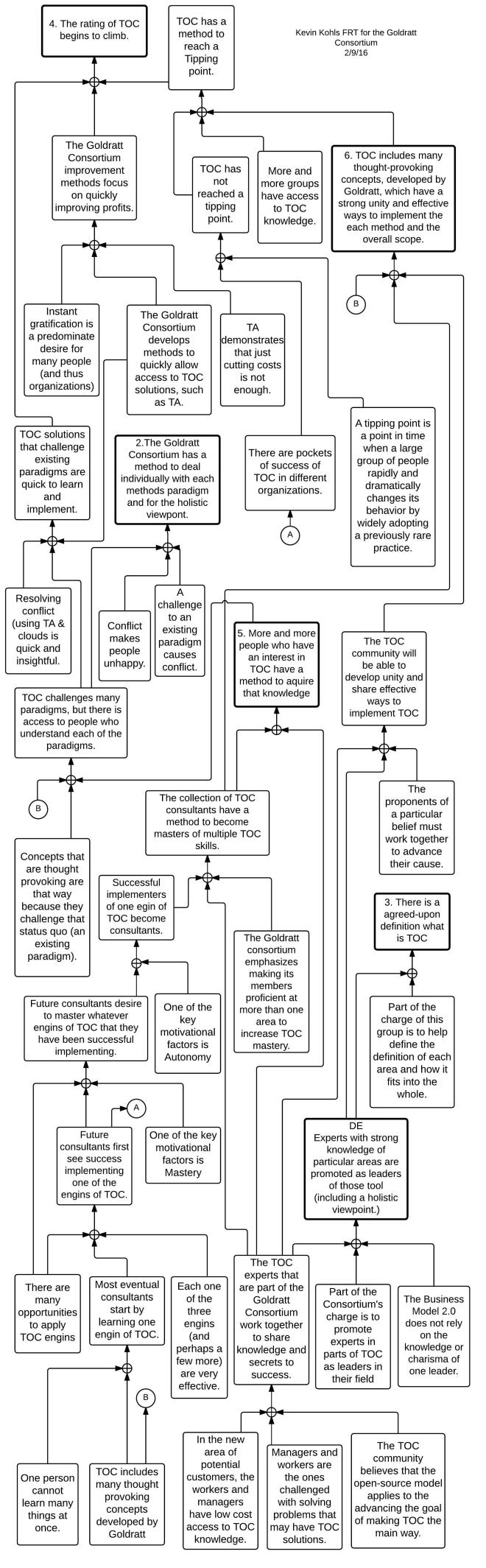
Kevin Kohls has a similar idea of a consortium with different scope.  Here are the main ingredients of his solution:

The Goldratt Consortium – Brainstorm

  • A virtual group that would meet by teleconference on a regular schedule and perhaps before or after TOC-ICO.
  • Their Goal is to make TOC the main way, and a Necessary Condition is to make money.
  • It’s its members will be anyone who wants to pursue this purpose, but should include consultants, academics and TOC customers.
  • They have a holistic framework based on the S&T trees, with appointed champions in key TOC areas: Throughput Accounting, Thinking Process, CCPM, etc.
  • Part of their objective is to give better definition to what TOC is and isn’t, and talk through other perspectives and tools that are not within TOC, such as Lean methods, Motivation, Routines & Habits, Resistance to Change, etc., and see how they should or should not fit into TOC solutions.
  • Non-profit training is one of the highest priorities, especially for it internal members.
  • They are always trying to reduce implementation lead time for their tools.
  • Recommendation of one or two tools that are the “best” tools for speed and quality. This could generate a few negative branches.
  • They should do some work on a non-profit basis, with the objective to pass the work on from one expert to another as the veiled holistic approach is rolled out.

Kevin added the following FRT:

UDE's of the TOC community - TOC Consortium FRT  (Copy)

Marketing the Value of TOC

If TOC is a supreme management approach how come we have such difficulty to market it?

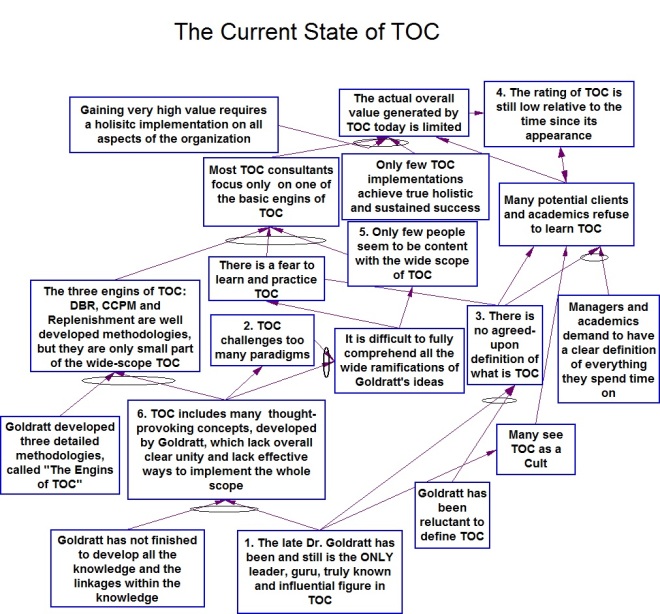
I believe this is the most common question of all the TOC enthusiasts. It is the one fact of life that points to a potential hole in the generic approach.  I have heard many explanations, including from Goldratt himself, as well as from people outside of the TOC circle. The key undesired effects (UDEs) of the current state of TOC are:

  1. The late Dr. Goldratt has been and still is the ONLY leader, guru, truly known and influential figure in TOC.
  2. TOC challenges too many paradigms.
  3. There is no agreed-upon definition what is TOC.
  4. The rating of TOC is still low relative to the time since its appearance.
  5. Only few people seem to be content with the wide scope of TOC.
  6. TOC includes many thought-provoking concepts, developed by Goldratt, which lack overall clear unity and lack effective ways to implement the whole scope.

I have heard from many people the first five UDEs. The sixth one is my own observation and it differs from what Goldratt believed just before his death.  Goldratt view was that TOC has reached the level of robust knowledge that can be put in a template and be repeated. I don’t think this is the current state, but I believe it is possible to achieve it.

TOC challenges many paradigms v5

I have outlined the CRT of the current state of TOC based on my views and rationale. Of course you all are invited to challenge every link in the tree.  There are TWO resulting big damages:

Many potential clients and academics refuse to learn TOC

and

The actual overall value generated by TOC today is limited

The latter one is the ultimate measure of the current state. The problem is that it is in contrast with the belief of thousands of Goldratt people, students and followers that:

TOC has the potential to bring HUGE value to the vast majority of the organizations

We currently lack a single person that has the charisma, intellect and character to take over the leadership of the TOC community to eventually achieve the goal of having TOC as the recognized way to manage, and by that generate huge value.

Do we really need ONE leader to carry TOC ahead?

The resulting personal core conflict is between every person operating individually according to his/her power and depth of knowledge, or collaborating in a synchronized way with many others to overcome the UDEs and especially unifying the knowledge to be effective for marketing, sales and implementation that would deliver huge value.

TOCICO supplies some of the necessary conditions to lead the TOC community to new achievements. It allows new people access to knowledge in various ways and it provides the infrastructure to meet other people from all over the world in an annual conference, which gives the chance for TOC experts to demonstrate their own abilities.  But, TOCICO does not initiate business, does not educate and does not support any implementation.  TOCICO has initiated the white-paper process to progress the body of knowledge, but so far it has not yield much response and new knowledge.

Here are some options for the basic Strategy for a TOC consultant:

  1. Operate on your own.
    1. Rely on the name of TOC, Goldratt and ‘The Goal’ to get better chance to get projects, which are entitled according to the methodology used: S&T, TP, Supply Chain in the TOC Way or CCPM.
    2. Stop using the name of TOC and present yourself as a versatile problem-solver, tackling any major problem or major opportunity of the client. You may, or may not, use the techniques of TOC to deliver the value.
    3. Combine TOC with other methodologies, like Lean or DDMRP and offer the combination as your own special advantage.
  2. Create or join a larger real or virtual organization, and by that be able to offer higher chance of generating real value to the client as more highly skilled people are involved.
    • A large organization can be more effective in developing the missing parts in the knowledge and offer auditing as a mechanism to keep the right track.

Let me just state that the big consulting companies are not attached to a specific methodology, but they gain a competitive edge, some of them a truly decisive competitive edge, by being big with wide experience.

TOC has very strong international spread, and the accumulative experience is pretty wide if we succeed to bring it together.

Any other idea that might lead you, a TOC consultant, to achieve a decisive competitive edge?

A practitioner within an organization who strives to make a real change that would yield a leap in performance has to be careful in dealing with several threats:

  • Being viewed as a Goldratt zealot.
  • Failing to understand the different perspectives of other functions.
  • Ignoring the personal power game within the organization depending where the practitioner is located within the organization chart.
  • Failing to identify the risks and thus not looking to reduce them.
    • A risk is a probability for a considerable damage.

I claim that involving an external TOC consultant in internal implementations offers higher chance of success even when the internal TOC champion is very knowledgeable. The seemingly objectivity of an outsider causes less internal tension.  The other reason is that an outsider has a bigger chance of coming with a truly new paradigm that is not common within the specific business sector.  New paradigms have the potential of generating huge value, because the competition is slow to digest the paradigm.

Let’s have a public open discussion about the problem that is common to all of us. Please respond by commenting what direction of solution you see.