The Frustration of a Middle-level Manager – A short story by Eli Schragenheim

My boss, Dr. Christopher Logan, asked me to come to his office at 2pm sharp, and report in detail how come the delivery to MKM did not have all the 100 B12 units. I know how such meetings are conducted:  it looks friendly enough, but actually there is nothing friendly in such a meeting.  The kind of attitude, “we are nice understanding people” is supposed to hang over, but beneath the politeness you’re on TRIAL – try to prove it is not YOUR incompetence that caused the trouble.

Such a hostile inquiry takes place every two months. Many things go wrong every day, but only few receive this kind of treatment.  It is usually because the client is very important, very big or new, and when such a client is making a complaint then the incident becomes critical and somebody has to be blamed and punished.

MKM is both big and new. From whatever reason, getting 97 good units, out of 100, exactly on the formal due-date, was not enough for them.  I promised immediately to deliver the missing three units in five business days.  Apparently this was not good enough, so a formal complaint was put on Dr. Logan’s desk.  I have no idea how come the delivery of all 100 units at the promised day is so sensitive that 3% less is such a disaster.

I’m now preparing my defense, trying not to exaggerate too much the role of Freddy in the blunder.   I know that almost every one of my people might have done the same mistake he did, and that mistake only partially led to missing the delivery.  As MKM demanded 100 good units that would pass their test in full no later than June 1st, 2018, we decided to produce 120 units, as there is no viable way to identify such quality exceptions in B12 production in an early stage.  Freddy mistake was assuming that a temperature of less than 1 degree above the standard is still within the control limits.  Usually this is right, but for MKM specifications it is not.  That small deviation impacted, at most, five units, because the temperature was fixed very fast.  Five out of the extra buffer of twenty cannot be the only reason that only 97 units passed the MKM test.  We, by the way, sent 101 units that passed our own test, rejecting 19 due to variety of reasons.  How come four units, which passed our test, failed in their similar test is an open question. No one, I repeat, NO ONE, has any explanation for this fact.

This is the situation I face and I just hope it won’t turn out as bad as the blunder of last year, which led to the layoff of two good people. The charge was not paying enough attention to rare and unfortunate incident that caused the breakdown of expensive equipment.  In such cases, Dr. Logan is taking the juridical authority to find who to blame.  I actually understand him; his superiors would blame him unless he succeeds to find another scapegoat.  So, it is now my mission to avoid being the scapegoat.  I hope I’d succeed also to prevent Freddy from such undeserved verdict.

Part of the pain we in feel in Operations is that things could have been much better if we would have known more about the clients true needs. We are told not to be in touch with the clients, so all I’m able to know is what is written in the documents submitted by the clients.  We only see the name of the client, the name of the responsible product manager and a list of specifications without much detail.  The product managers also know very little on the client true needs.  I suggested Larry, the product manager responsible for MKM, that we deliver first 50-60 units of the order already in May 16th and two weeks later all the rest.  The reason was that we had to split the order into two batches due to some technical difficulties.  Larry called them and got a refusal, but no explanations.

Why?

Why do I have to function under strict instructions which I fail to see their rational?

Why I meet the executives, to whom Dr. Logan reports, only in special public ceremonies?

All I see above me is Dr. Logan. The rest are located far away and there is no active dialogue between me and them.

I stay in this company, first of all, because I have a wife and two small daughters. I also think I’m doing a very good job.  I cannot prove it, but I think that under someone else, with less experience and technical knowledge, the MKM failures would triple.  Most of the time the procedures we have, and the willingness of my people to react to any signal pointing that something might be wrong, keep what I consider to be very good overall quality of operations.

But, the ridiculous performance measurements look as if our performance is just moderate. The cost of our operations is, according to the measurements and the funny benchmarking they use, somewhat higher than the “average” of similar facilities.  This is so wrong that it is an insult!  If you don’t even contemplate to listen to us in order to understand what we do and why we do it this way, how do you expect us to improve?

I feel the situation is “us against them” – the people who do the job against the people who play the role of God and judge our performance, even though in some public speeches they say “we have to do much better”, making the wrong impression that they think they should improve as well. I don’t think Dr. Logan believes he has to improve.  He has me and my people to improve, and it is just me who has to learn the lesson and make sure the MKM case would never happen again.

So, here is a potential action plan. I shall argue that the whole incident happened because Sales intentionally concealed part of the detailed specifications of the order, being concerned we’d reject the order, because we don’t have the capability to do it right.  Larry, the product manager, told us that the chief salesperson hinted that MKM has the most sophisticated equipment in the world.  I didn’t see the implications at the time, but it is evident now that such equipment allows more precise measurements, so it could be that the true specifications were not given to us because our equipment is unable to meet such precise specifications.

Does MKM really needs more precise specifications for their products?

Fact is that 97 units have passed the test. It means that our equipment is able to achieve the required specifications. But how can we test the final quality when our testing equipment is not the same as MKM new testing equipment?

Human relationships as a part of the holistic approach in managing organizations

Management is about achieving results for the organization. The obvious meaning is that integrating the various organizational functions, like Sales, Operations, Finance and R&D, together to achieve the best performance is what the CEO has to accomplish.   This is the holistic approach: integrating the parts into a whole entity.

What is the role of HR in this need for integration?

In every part of the organization there are people who are truly required to achieve the global objectives. Every resource has a set of capabilities and a certain capacity that limits the amount of output in a period of time.  When it comes to human resources both capabilities and capacity are much more difficult to define and measure than the other types of resources, like machines, space and money.  But, the limitations of both human capabilities and capacities play a considerable part in the performance of the organization.

The characteristic of human resources is such that to properly utilize their capabilities the right motivation has to be active. For instance, a salesperson is meeting a new potential client.  Would she do everything she can to bring the client in?  Is this true also when she isn’t entitled to a special bonus for that?  Similar situations are a purchasing agent negotiating price and terms with a supplier and a foreman who gets a special request to expedite an order, which requires extra efforts.  Eventually all the above examples depend on the willingness of employees to help the company to prosper.

People might cause unintentional damage by failing to act in the right way. This could happen because of being untrained, or incapable, to do the job properly.  Another cause is flawed procedures and measurements that push people to do what harms the performance.  TQM, Lean, Six Sigma and TOC act in their different ways to fix that.

There are very few cases, but causing huge damage, where employees intentionally harm the performance of the organization.  This could take the form of refraining from doing what is required, like a strike, or even taking concrete actions that disrupt the performance of the organization.  It is definitely the responsibility of top management to prevent such high damaging cases, which raise emotions, like rage, preventing win-win solutions.

In the vast majority of the cases employees simply do their job as being told by their superiors.  When top management is doing a good job in integrating all the parts into synergetic performance than the results are positive, otherwise the employees cause damage, exactly because they follow instructions.

Can employees add high value that is far beyond just doing their job?

High level employees, like executives and highly professional employees, are expected to make huge efforts beyond their job. Question is: what is expected from the rest of the employees?

It is definitely possible that relatively lower level employees might know how to help the company to do better. In most cases the employees decide to keep quiet, believing the boss would not listen or appreciate their ideas.  Many employees feel that helping the company, beyond the formal description of the job, is a waste of their intellect.  This is a declaration of indifference:

“This is just my job, not my life. I’m not going to waste my intellect and special efforts for the organization that does not employ me for that purpose.”

So, the message for top management is that the employees might become a problem, either because they are not capable or because they are not motivated to do everything they can for the sake of the organization.

Henry Camp is the CEO of Shippers Supply Inc. and the owner of four other companies. Henry conducted a TOCICO webinar highlighting the 10 steps required to achieve the active collaboration of the employees for the company.  A special emphasis was on being ready to assist implementing a change in the way the company operates.

Henry Camp webinar is focused on what management should do to ensure that this indifference would never happen, preventing also the damage of intentional acts of frustration of the employees.

I recommend the reader to watch the recording of the webinar on the TOCICO site. A somewhat shorter alternative is watching his 30 minutes video on YouTube:  https://www.youtube.com/watch?v=4B0Azc6MNn0

I like to raise the issue of a CEO who is either new to the organization, or have not paid too much attention to the human relationships culture in the organization and now realizes that the time has come to diagnose the current state.

How much effort should management dedicate to diagnose problems with the motivation of their subordinates and solve them?

The objective is to find out whether the current performance of the organization is seriously harmed by existing level of distrust between employees and management. In the terminology of TOC the actual question is:

Is the internal human relationship the core problem of the organization?

The easy, but not always the best way, is inviting organizational behavior consultants to do the diagnostic. The result often is lack of focus, as the tendency is to come up with long list of what needs to be fixed.  The true damage to the Throughput is usually not defined.

There are two key organizational flows that determine the rate of achieving the goal. The first is the current flow-of-value to the customers.  The second is the flow of initiatives to improve the flow-of-value.  The concern from the impact of behavior on the current flow-of-value is creating blockages and by that harming the reputation of the organization.  The main concern for the initiatives is not trying hard enough to come up with great innovative ideas.

The chronic problem of the organizational culture is not with individual employees. Such problems are relatively easy to handle.  The problem is when most employees radiate indifference to achieve more of the goal.

Dealing with power groups within the organization is a situation that can easily become disastrous. Every airline has to manage its relationships with the pilots with extra care, while all the other groups are watching and might react to any change in the status quo.  In hospitals the surgeons have extra dominance and universities are run by full-time professors.  The balance between the power group, top management and the other groups is quite sensitive.  It is possible to get a win-win for all the groups, but it is not easy to maintain it for long time.

Can we apply rational cause-and-effect to diagnose existing or emerging behavioral problems and then find the effective win-win?

There is a common claim that people behave irrationally and thus analyzing it with rational logic is not effective. The argument is that we, human beings, often act based on impulses, stirred by emotions, leading to behavior that seems irrational because the actual results to the person are bad.  For instance, criminals behave in a way that eventually leads them to be in jail.  Question is whether the decision to make a crime is irrational from the perspective of the person committing the crime? Criminals could choose to satisfy their immediate desires in spite of possible negative consequences, as they judge being in jail less negative than most people.

Is human behavior often unpredictable?

If the behavior is the result of known causes, like the desire for dominance on other people, then the logical analysis should lead to expected behavior that is in line with reality.  Most of the time we predict the behavior of people we are communicating with well enough.  This is also true for managers predicting the response of their people and vice versa.

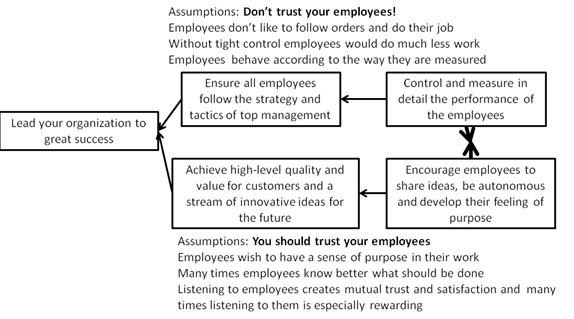
When negative behavior of employees can be predicted then it might appear on one side of the core conflict of the organization. For instance, when management distrust their employees they could suspect that the employees would not cooperate in introducing a change.  Such a conflict looks like that:

cloud management employees

Suppose that indifference is causing many undesired effects that reduce the potential of the organization to achieve more of the goal. Does it mean the indifference is the core problem?  Or the indifference is a symptom caused by another effect that causes several other undesired effects?

Most of the time indifference is caused by the reluctance of management to trust their employees, or by poor performance of the organization that harms the morale and the trust of the employees in the management. Both causes have more negative ramifications on the organizations.  Having to control everything has a huge negative impact on management attention, and from that on the ability of the organization to grow.

This basic trust and sense of purpose should be carefully maintained by the management of the organization. When there is a change in the mutual trust between management and employees then new emerging undesired effects should signal that such a change is happening.  A drop in the delivery performance to customers could be such a signal.  Failing to meet commitments, reduced quality and increase in customer complaints should be carefully viewed and monitored.  When such a change in the mutual trust is validated, the next step is to understand what happened to this sensitive balance.   Understanding the causes for human behavior is very much needed at this stage.  When such signals are not observed, then the focus of management should be elsewhere – on what truly constrains the performance of the organization.