The Role of the Consultant in the Life of an Organization

Specific Unknown Problems

It is natural to joke about consultants. A management consultant is an informal player in the power game within the organization, because he does not belong to the hierarchy. The consultant also does not take any responsibility and only rarely he has real-life experience as a manager.

There are two different types of management consultants. The first consists of those who see their role as facilitators that encourage people to express their views and help them to properly radiate them.  These consultants shy away from expressing their own opinion on any subject matter.  In this article I do NOT address this type of consultants.

The other type of consultants clearly express very strong opinions. Most of those consultants make a thorough inquiry of the organization needs and then produce a document stating exactly what needs to be done.  The big strategic consulting companies, like McKinsey, follow this approach. A different approach is where the consultant comes with certain ideas, but carries a dialogue with the client until a consensus is reached.   I believe this is the way TOC consultants should follow.

Why do executives need consultants?

When the consultant is an expert in a very specialized area, like legal consultants or even marketing specialists, then the value is quite clear. While TOC is known mainly in Operations, the TOC BOK covers wide range of managerial areas, thus it cannot be considered specialized in a narrow field.  In other words, TOC consultants help the executives of a company to do the job the executive is supposed to do! The emerging problem is that it creates an unfavourable image of an executive who is unable to do his job properly and the TOC consultant has to do it for him.

When the consultant brings new knowledge that cannot be easily gained then there is a certain justification for using him. Question is whether the organization should not expect their executives to be highly knowledgeable on all the areas under their responsibility.  In other words, if TOC is not too specialized and yet it is relevant for the management of an organizational function – should not the executives be fluent in the relevant TOC knowledge?

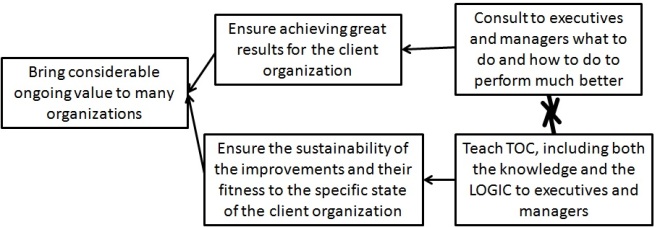
This brings us to a critical conflict within TOC that started way back in the 80s. As I’m preparing myself to a webinar on the development of TOC this conflict is causing me considerable thinking:
cloud consulting

In the early days of the Goldratt Institute the idea was just to teach. The real problem was the inability of many clients to quickly implement the general solution advocated in the class, which had caused huge delays in the results leading people to distrust the methodology and coming back to the common flawed methods.

Switching to full consultation, directed at the top management, has achieved results much faster, but, it also showed the problem in keeping the drive to achieve even better results.

I think that the only way to resolve the conflict is to challenge the conflict itself by providing both educating and consulting, not necessarily at the same time, but eventually achieving both.

The focus on consulting also raised the already mentioned problem of the image of managers wasting money on external consultation to do what they need to do in the first place. The big consulting companies deal with that image by offering knowledge on the common practices in similar organizations to establish the “best practices.”  The consultants are then viewed as bringing international experience on how recognized issues are dealt by others.  So, the ruling assumption is that it is possible, and beneficial, to imitate what others do well and by this achieve results.  This generates an explanation how come top executives invite international consulting companies to lead a change, based on benchmarking as a proof for excellence.

Personally I think that benchmarking leads to disastrous results, because they are derived by generic similarities, which do not fully match the map of cause-and-effect, especially the impact of certain unique characteristics that every organization has. On top of that I think that every organization has to build the way to success upon certain unique capabilities, which is quite contrary to benchmarking.

The answer to the image of wasting money to do what management has to do is that external consultants have the ability to bring perspective and ideas from outside the specific business area.  The TOC training generates capabilities for identifying the essence of problems and the generic ways to overcome them.  TOC is also tuned to identify flawed paradigms, for instance all those that stem from local perspective.  This is an ability that even the top best executives cannot easily have, because most of their career they were in the same area and thus have adopted the same set of paradigms that only someone external can see the flaw.  Note that when a paradigm that is shared by all competitors is proven invalid in certain aspects the opportunity from the updated paradigm is huge.

There is a related, still different, advantage for an external consultant. An executive, especially the CEO, is quite lonely in his/her hard decision making. Consulting anyone else within the organization has negative ramifications on the image of the executive within the organization.  Consulting with an experienced clever consultant answers a basic need.  We know that hard decisions mean that undesired outcomes might be caused.  This is the nature of living in uncertainty with the various biases that we all carry with us.  Discussing the benefits and the negative branches and then how to eliminate the negatives is a real need.

So, what are the requirements from an external TOC consultant to truly deliver value? The TOC formal knowledge can be effectively gained by courses and books.  The ability to connect between generic insights, many of them challenge rooted paradigms, and the special characteristics of the organization require critical dialogue between the executives and the consultants.  It is never “Do that and that – believe me it’d work”, it is hard thought processing that needs both the internal and the external minds to find the effective solution.

What if the consultant himself feels trapped between the generic ideas and the environment at hand? It should be a common occurrence because the translation of generic ideas to specific environments is never trivial.  Think about the possibility of a consultant in a specific project discussing the matter with another consultant, who is not in touch with the specific environment. This is where I believe veterans like me can give value.

The benefits of the S&T tree – and some limitations

I define Strategy (with capital S) as a plan to achieve more of the goal.  The technique called Strategy and Tactic Tree (S&T) is nothing more, but also not less, than a format where the plan can be articulated, including all the intermediate objectives (IO), the actions required to achieve them and the assumptions behind.

The need for such a format is that any Strategy has to include many elements that have certain dependencies between each other. When Marketing comes with an idea that hopefully would bring high demand the resulting question is whether Operations is able to deliver according to the market expectations.  Another question is whether other sales are going to be impacted.  Many other possible dependencies exist that should be considered in the planning.  The format of a tree gives a better view of the map of the linkages between different IOs and their related actions than a document or even the HTML format.

See for instance the following basic tree describing a generic structure of a part of an S&T. The term DCE stands for “decisive competitive edge”, a critical element for delivering unique value to potential clients.

Standard Strategy part1

Within the S&T structure every function in the organization sees what is required to achieve and how to do it. At the same time every one can see what should others do in order to reach the desired objective(s).  Ask yourself whether this is the current situation with your organization.

Another great insight by Goldratt is separating the intermediate objective from the actions to be taken.  The above figure shows the basic tree of “strategies” (same as intermediate objectives).  Within every single entry the planner has to clearly define the actions to be taken and the assumptions stating why the strategy (IO) is necessary and why the actions would achieve that strategy.  We have now enough experience to testify how constructing the tree, verbalizing both the objectives and the actions and justify them through a set of assumptions, improves the completeness of the Strategy and makes the probability of achieving it higher.

However, the S&T is still just a format.  The ideas, the analysis of their impact and the ability to manage the execution are not impacted by the use of S&T.  It is my strong conviction that the intuitive Strategy has to be in the mind of the key people in the organization before coming to put it into the S&T format.  Most certainty the key decisive competitive edge ideas have to be already clear.  Discussing the various options to move the organization have to be completed by the time the detailed S&T planning starts.

I believe going to plan the gross Strategy using the S&T format yields much higher probability for success.

I’m not going to teach here the S&T. You can learn it online at www.harmonytoc.com. I advise you to go through it!

There are two different limitations of the S&T that I like to note and discuss. Before that I like to state my observation of a seemingly obstacle that I don’t think truly exist.

The perception given is that writing the S&T is a sensitive mission that requires high expertise!

This is NOT the case! I’m against being too overly careful with the verbalization and the statement of the assumptions.  Personally I don’t care whether an objective is verbalized in the most effective way – as long as the key people of the company understand and agree to the underlining meaning.  I think too many TOC consultants and practitioners get frightened by the difficulty.  Sorry, I think that outlining the S&T is straight-forward, and even if you made a “mistake” and write an entry not in the right level, or write it in too long sentences – I don’t see the damage.

The limitations I do see:

  1. There is a certain ambiguity in the linkage between the low level entries and the higher one. The question is what is achieved when only some of the lower level objectives have been completed.

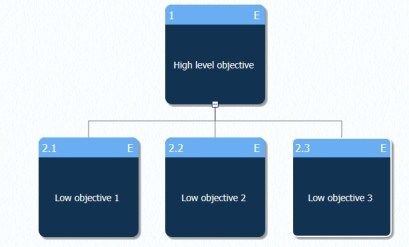
Very small example

Suppose entry 2.1 has been successfully achieved, what is the impact on entry 1? We cannot expect to achieve the full high level objective. But, shouldn’t we gain something at the high level? The linkage does not state it.  The only valid assumption is that when all three low objectives have been completed then we get the full high level objective.  As every plan has to include signals for the execution phase that indicate how well, or not so well, the plan is progressing – those signals are missing from the basic S&T format.  The expectations from partial completions have to be somehow attached to the S&T.

  1. The S&T does not include buffers!

I do not necessarily refer to time buffers. Some think that the S&T should have a due-date, or a lead-time, to be fully completed.  The value of such a due-date is forcing commitment on all the key players.  In itself the due-date does not mean anything.  If my stated lead-time for the whole S&T is four years, then completing it in five years might mean less benefit, but then it also depends not just on the time, but also on the quality of the achievements. Generally speaking we like to achieve the plan as soon as possible.

Suppose you find out that low objective 2 proves to be too tough to achieve. Does it mean that the high level objective cannot be achieved? Does this mean the whole S&T cannot be achieved?

Sometimes all we lose is just somewhat less effect, but the Strategy is still intact. On top of that in reality we do have alternatives.  The format of the S&T is not friendly to introduce alternatives like “Alternative low objective 2”, which might yield less spectacular results for the high level objective, but still keep the overall Strategy in place. Planned alternatives are buffers that protect the whole plan from being stuck.

The bottom line from my perspective:

Planning the overall Strategy, including identifying at least one DCE, is the most important mission of top management.

The S&T significantly improves the effectiveness of the Strategy and also provides superior communication of the Strategy. Understanding both the benefits and the limitations, as well as keeping an open mind, are required to support this critical mission.

Learning the Good and the Bad from Yield Management, a methodology developed by American Airlines

Airline Passengers in an Airport

Yield management, also called Revenue Management, is a pricing methodology used by all airlines that has spread to other business areas. Wikipedia defines it as: “Yield management is a variable pricing strategy, based on understanding, anticipating and influencing consumer behavior in order to maximize revenue or profits from a fixed, perishable resource.”

The interesting point is “perishable resource” meaning when you don’t use it you lose the potential revenue.  Seats in a specific flight are a natural example.  Once the flight takes off the opportunity to sell the empty seat is gone.

Isn’t it the same for the capacity of ALL RESOURCES?

A machine that is idle today – that part of its capacity is lost forever. We in TOC are well aware that capacity lost on the bottleneck means lost Throughput.  Yield Management looks on seats in a flight as a potential constraint.  This is a valid view of looking on the micro-capacity, like a flight or one day in a hotel, as an independent opportunity to fill the whole batch and gain more sales.  We can compare the situation to using an oven in production wishing to fully utilize its capacity by putting several different products in the oven.

Most travelers need the flight at specific dates and time in the day. This provides an opportunity to increase the price when the demand seems relatively high, because changing the date of the flight is not a proper alternative for many, and thus they are forced to pay higher price for exactly the same service.  On the other hand, when the expected demand is low then offering very low price could steal customers from other airlines and earn revenues that would be otherwise lost.

Yield Management is an exploitation scheme of every instance of the capacity of a critical resource. At the same time Yield Management exploits the market demand by reducing the price when low demand is expected. This basic objective of Yield Management is definitely in line with the five focusing steps!

The means of exploitation of the constraints are different than the regular TOC approach. TOC would first look to exploit the aircrafts, assuming they are the constraint, searching for ways to make more flights yielding overall more T.  Yield Management looks on every micro-capacity of the constraint, every single flight, in isolation.  Service often requires the customer to be physically at the specific time and location. This makes service organizations exposed to many more peaks and off-peaks than manufacturing.  The other difference is the heavy use of dynamic pricing.  Goldratt wished to use as much market segmentation as possible, certainly using response time as a justification for higher price, but not to the level used by airlines or hotels, which do not offer any justification to the customer for their crazy pricing.

A hidden assumption within Yield Management is that the truly-variable-costs (TVC) are zero. This is about right for airlines and hotels. One of the first articles on Yield Management by American Airlines (where Yield Management was first developed) did state this assumption and even add in parenthesis that adding a traveller to a flight has a certain cost, but it is pretty low and can be ignored.  Applying Yield Management to renting cars requires using Throughput instead of revenues, because there are TVC, like the costs of spare parts that are proportional to the miles driven.  Using Yield Management, but with T instead of R should be a major insight for many businesses, assuming dynamic pricing is acceptable by the market.  As I have already noted – the capacity of every resource is “perishable”.

It seems to me that the main flaw of Yield Management is the crazy run for optimization.  The airlines developed super-sophisticated algorithms not just to predict the probability of running out of seats, but also the chance of a seat to be sold at a specific higher price!Daily forecasting of a flight, two or three months before the take-off, causes frequent price changes in a manner not understood by potential customers and travel agents.  This general dissatisfaction of the clients, and agents, provides an opportunity for a competitor to change the rules and gain leap in performance.

The assumption adopted by all airlines is that the market would not react too harsh against dynamic pricing.  Many travellers know that the probability that their neighbour in a flight has paid the same price is quite low.  No one likes it, but as all airlines use this dynamic pricing the travellers have to find ways to fight back, like extensive search for the cheapest flights and becoming more flexible with the timing.  The fact that the current price can change in one day puts the customer under pressure.  I think that if a certain airline would adopt a strict policy of pricing relative to the time until the take-off, the customers would be more content and the appeal of that airline will grow.

What keeps this reliance on forecasting and optimization algorithms from customers running away are two effects:

One is the simple fact that all airlines imitate each other in almost every detail.  The entrance of the low carriers has rocked the boat of the airlines until a certain balance has been achieved and the massive imitation continues. I believe that if a significant airline will introduce a major change in the pricing rules it’d take time for all airlines to decide whether to adopt it or not, meanwhile the balance within the airlines will change.

The other effect is the impact of the frequent-flier programs that create loyalty of the best customers to a specific airline. This is an enormous marketing success of creating special value to customers and it neutralizes, to a certain degree, the negative effects of the crazy dynamic pricing.  The readiness to give free tickets (not truly free – just much cheaper) to passengers is based on the realization that the cost is very low. We should all learn the lesson, certainly we in TOC who are able to distinguish between T and OE.

While the airlines understand the need to exploit the constraint of an individual flight, they fall into the trap of the flaws of cost-accounting when it comes to decisions about whether to fly or not to fly and what routes are profitable. So, they recognize the impact of the capacity constraint for a flight, but not for the aircrafts (or the terminals in certain cases), which are their critical resources.

Learning from the good and bad of the management practices of other methods or of other business areas should be a core value to TOC.

“Never Say I Know” and the Limitations of our (Reasonable) Knowledge

To do or not to do

The above “cloud” describes a generic conflict of living under the limitations of our knowledge.  Goldrartt coined the epigram “Never Say I Know” to guide us to always look for signals that challenge our current understanding and by this prepare the next leap in performance.  Problem is that recognizing the limitations of our knowledge might cause paralysis, trying not to do anything that we don’t have to, certainly not to take any decisions that lie outside our “comfort zone”.  Taking actions only within the comfort-zone is a wide-spread compromise of the conflict.

Being fortunate to work closely with Dr. Goldratt included the not-too-nice, but extremely inspiring, experience of answering him “I don’t know” to a pointed question.  He got angry, pushing me to verbalize what partial information I do know and how it leads to the best answer we can have. The only reason, according to Goldratt, of not knowing anything is not caring.  When you do care you notice certain effects that logically lead to certain conclusions, even though far from being certain. This experience led me to recognize the following statement:

Never Say I Don’t Know Anything

This recognition is an even more pointed paradox than the above conflict.  How can we both know and don’t know?

My resolution of the paradox, focused on decision making, is the recognition of the wider impact of uncertainty, recognizing two parts of our knowledge – the part we believe we “reasonably know” and the part we know we don’t know.  A new element we have to introduce into both conflicts is the term “reasonable”, describing what we think we know with a certain level of certainty, still recognizing the fact that in some infrequent cases we are wrong.

Assessing our reasonable knowledge is much more concrete when we predict what is reasonably NOT true.  Let’s view some examples.

  1. Two teams in sport. Team A had, so far, 10 wins to 0.  Team B had, so far, 10 defeats to 0. Who is going to win?
    • We could assume that the optional result of B winning is not reasonable.
    • When a draw is a possibility (like in soccer) then a draw might be regarded reasonable.
    • We can also assess what results are not reasonable. For instance, if the example is about basketball than a result of 100 to 0 is unreasonable.  Someone with better intuition might even claim a win by 60 points or more is unreasonable.  This assessment of what outcomes are not reasonable, leaves quite a lot of latitude to what is reasonable – and this leaves us with the reasonable boundaries of what we don’t know!
  2. Predicting the rate of growth of the economy.
    • All the current knowledge, based on the past and on understanding the markets would lead to outline what rates are too reasonably high and also what rates are too reasonably low. This defines the range of reasonable results where we don’t know which one would occur.
  3. Nominating a new C-level executive.
    • We like to nominate someone who would not fail! This means that the criterion of the choice is that a failure of such a nomination is considered unreasonable.  It could be that we have rejected another candidate whom we reasonably assessed could achieve even more, but also might fail causing serious damage.

Even with this recognition of what is reasonably not true we still acknowledge the fact that in some, relatively rare cases, our reasonable knowledge are flawed.

The boundaries of what we-know-we-don’t-know include all the cases that we assess could reasonably happen – but we don’t know which one.  These are also the boundaries of the uncertainty as viewed from our perspective. I define uncertainty as everything I don’t know.  The decision-making process has to consider seriously the possibility of every potential outcome that lies within the boundaries of what we don’t know and to consider the range of the potential benefit and damage of all those outcomes.

There is a perception that TOC is against forecasting of sales and that there is no need to forecast sales.  I challenge this perception.

The real problem with forecasts is the basic misunderstanding of what information should be conveyed by forecasts.  We absolutely need sales forecasts to tell what level of sales is unreasonable, so we can prepare for the range of possible reasonable demand.

Suppose the inventory target level, according to the TOC replenishment solution, for product A is 100 units.  Currently the on-hand stock is 30, and two orders are on the way – one for 40 and another for 30.

Buffer management tells you that the on-hand stock is in RED.  This means we assume it is reasonable that the demand in the next day or two might exceed 30 units. Thus we have to expedite the next order. However, the possibility that tomorrow the demand would exceed 140 units is considered unreasonable!  This is the forecast we use in TOC – predicting that within regular response time the demand will not exceed the target level!

Suppose you hear a rumor that a major competitor is going to close his business in three or four days.  It is a “rumor”, not a hard fact, but how many important real hard-facts, which could have big impact, are you exposed to when you have to make a critical decision?  Suppose you think this rumor is “reasonable” and if it materialized then the demand for your products would go up.

Would you take actions based on a forecast, which is based on a rumor?

I know I would, maybe very carefully not to cause too much damage of overproducing when the demand might not go up at all because the rumor could be false.

This is the essence of living in uncertainty, partially knowing and partially not knowing.  We need to make decisions that would never hit us too seriously and most of the time will bring huge benefits.

Managing Educational Institutes

Written by Eli Schragenheim and Dr. Shoshi Reiter

Managing is all about achieving a common goal.  In business the most common goal is to make money now and in the future.  Hospitals strive to make patients healthier. Education is about making people, especially young people, much more knowledgeable and valuable citizens.

Hand drawn cartoon characters on textured background - children

TOC for education (TOCFE) has a lot of implementations around the world in pedagogy, mainly in curriculum and students behavior.

What is the organizational contribution to support and improve pedagogy?

The long-term goal of any school or faculty might be verbalized like this:

Enabling pupils to draw the best from themselves and become valuable and contributing members in the society.

Specific educational systems should declare a more concrete, yet long-term, goal.  The social environment of the specific institution certainly has an impact.  A school in a poor neighborhood has a different emphasis than schools in rich areas. The Engineering Uni. department might have a specific goal different from the Business department.   Certain values and specific areas of knowledge could be seen as of utmost importance and by that differentiate the goal from others.

Managers define many times goals that are actually short-term intermediate objectives. For instance, “Recruiting more students to my faculty”, “Higher academic scores in national test”, “Prevent dropout from school”, “Improve well-being at school”… These objectives are not the ultimate goal; they represent what the managers believe they need to focus right now.

What is the possible contribution of TOC to the management of educational institutions?

Improving the quality of pedagogy is an important element to achieve the goal. Yet, some other aspects of school management are no less challenging. We have an organization with a group of different resources (e.g. human capital, real estate, and budget) stakeholders and community that exert various pressures on the institution. Our assumption is that every manager has several degrees of freedom in managing their organization (school, faculty…). From all of these a critical question is raised:

How to manage the educational organization effectively in order to achieve more and more of the goal?

How do we measure the relative achievement of the goal during the process? How long do we wait till we realize we have lost track?  Maybe our actions are not effective and do not lead us to the goal? When do we learn from mistakes and make the necessary changes? What is the mechanism that helps us correct before it’s late…

The main indicators used today are based on exams and the personal evaluation of the teachers. Question is how much analysis is done to quickly identify emerging problems and fix the educational flow of knowledge, skills and values, to the students.

We like to highlight a key difference in the meaning of ‘flow’ between education and all other organizations. Students go into education system for a fixed period of time.  So, the basic concept of lead-time is meaningless in the educational system.  What becomes even more important is what the student has managed to get and digest in this fix period of time.

Goldratt defined three fears of management: Complexity, Uncertainty and Conflicts. Running a school with many teachers, each is doing a seemingly independent job, but recognizing the fact that eventually every pupil is a holistic mission, calls for the emergence of conflicts. When we take the external stakeholders, especially the parents, into consideration, then quite a lot of the time of the typical school manager is occupied by settling conflicts.  The TOC generic win-win approach and the detailed technique of resolving conflicts (evaporating clouds) should not only lead to better resolutions, but also to faster treatment, freeing the manager to focus on how to improve the flow of knowledge and skills to the students.

The difficult part is to view and measure the effectiveness of the quality of the flow, especially of the overall impact of the education on all the students. This problematic area calls for employing the Thinking Processes (TP), not just for teaching students the TP, but for developing a structured analysis of the various signals, including the grades and their relationships between classes and between years, and identify both the constraint and the core problem of the specific educational system.

Applying the five focusing steps has a lot of potential to guide the managerial focus to deal with how the constraining resource should be exploited. Most educational institutes are part of the public sector and they have to operate based on a budget dictated by either the municipality or the government.

In a given fix budget situation the high-level constraint generates a lower-level constraint!!!

The budget forces limitations on the teachers and class-rooms. When we assume that more teacher-hours per pupil would improve the achievements of the goal, then the limitation imposed by the budget generates the operational constraint of teacher-hours.  The budget can also limit the number of truly excellent teachers out of the total number of teachers.  So, assuming the manager faces X number of excellent teachers and Y number of okay teachers, the exploitation is based on how effective is the distribution of the X excellent teachers between the pupils and how the other teachers are pushed to their capability limits.

New pedagogic methods are frequently introduced into schools. Sometimes the manager has the authority to decide whether to implement a specific new method or not.  In other cases the higher level authority is the decision maker.  Even in the latter case the manager has to lead the actual implementation. The most critical efforts have to focus on early checking whether that method truly produces the expected benefits and if not find the required actions to fix the problems.  How should the signals, for good or bad effects, be analyzed?  The TOC Thinking Processes and the methodology of Learning from One Event could be of huge support in the difficult mission.

On January 30, 2016, Eli Schragenheim and Shoshi Reiter will deliver a free webinar on http://www.TOCICO.org on that topic.

Part 2 – Uncovering the Value of New Products and Services

Market Innovation Flat Icon Illustration

Continuing the first post on assessing the value of new products

Question no 3: What are the current usage rules, patterns and behaviors that bypass the limitation?

The third question adds a new angle by looking hard at the current usage and behavior. There are three reasons to clearly outline the current behaviors.

  1. It is a reference for determining the value. For instance, if reducing the limitations saves time, it is important to roughly know how much.
  2. Understand the power of inertia when a change is taking place.
  3. Drawing a good description of the target market segment.

Take the wine box that preserves the taste of the wine while pouring just one glass at a time. The regular way for drinking wine is opening a bottle, typically 750cc, and finishing it.  There are now ways to put a rubber cork and suck out the air by a pump, which allows reasonable preservation of taste for 2-3 days.

So, who would be interested in a wine-box?

Drinking a whole bottle is relevant for social and family events when there are several people. For an individual, or even a couple, who like wine this is a problematic limitation.

The email-service by a pharmacy saves time, relative to the current norm of waiting in a queue. When the pharmacy has enough agents to serve the public the new offer does not add value, unless the prescription requires lengthy preparation by the pharmacist.  So, we can see that the service is directed at relatively busy clients, especially those with prescriptions that need preparations.  The time saved is much more valuable in neighbourhoods with few pharmacies and thus are frequently crowded.

Question no. 4: What rules, patterns and behaviors need to be changed to get the benefits of the new technology?

This question applies to ALL new products and services. Everything required by the user to draw the best value should be acknowledged, because it is our key interest to ensure the client exploits the value.

The connection between the third question and the fourth outlines the difference in the usage and reveals the full value. More, the fourth question hints that it is not obvious that the client will be aware how to draw the value.  I think Microsoft should consider the possibility that common users, like me, might not be aware how to use Windows 10 to its best advantage.

Inertia is the enemy of everything that is new. We all are impacted by inertia, but when it comes to organizations the inertia goes up dramatically.  Many organizations have not, yet, fully digested the new possibilities opened by the Internet, for instance, how to work effectively without having the vast majority of the employees coming every day to work in the office.

The two examples are focused on individual users. The third and fourth questions when applied to the wine-box contrast the different use between opening a bottle with the intent to finish it and having just what the person likes to drink at that time.  The wine-box also allows drinking several different wines with the meal, without the feeling of wasting half empty bottles of good wine.

The email service requires Internet activity, including scanning the prescriptions and adding all other needs before going to the pharmacy itself for just picking up.

Question no. 5: What is the application of the new technology (product) that will enable the above change without causing resistance?

This is the latest verbalization of the question by Goldratt. The point is how to make the necessary changes in the product and the marketing based on the answers to the previous questions.  It emphasizes the common effect of resistance to the new.  Many times the resistance is because of some real negative effects due to the new product or service.  A wine-box made of carton might radiate inferior quality, and thus cannot fit real connoisseurs of excellent wine and those who like to gain status value.  The conclusion might be to position the wines in the boxes as “good, but not extraordinary”.  It still needs to be good, because why should someone use a 3 liter of not-too-good wine?  Wine is not usually consumed by those who like to get drunk.

Considering what is required to strengthen the value of the new product, and to shorten the time for the user to fully appreciate the value should be the main focus of the development process. Analysis of the email service for a pharmacy might reveal that it is worthwhile to provide home deliveries of pharmaceutical items in order to truly add value to a specific market segment.

Question no. 6: How to build, capitalize and sustain the business?

The sixth question reminds everyone to look for the holistic picture and inquire the dependencies between the new product and the overall Strategy of the organization, including the impact on the other products and services.

Highlighting the meaning behind the three critical elements of a Strategy:

  1. Build the full capabilities that are required to develop, produce and deliver the value to the clients.
  2. Capitalize on the capabilities to achieve the full impact on the market, recognizing the value and being able to purchase the products. This entry is focused on marketing and sales.
  3. Sustain the growth! Goldratt always emphasized the need to be properly prepared for success. The ramifications are on both the capabilities, especially the managerial capabilities to manage a much larger system, and on capacity – the limitations on the extent of usage of the capabilities.

The six questions call for more in-depth analysis and possible expansion. For instance, we certainly need guidance how to check the effectiveness of the portfolio of products and services.  The sixth question certainly reminds us to do that.  I’ll be glad to collaborate on further thinking on these issues.

Uncovering the Value of New Products – Part 1

A hipster Caucasian businessman exchanging idea for money.

As a management summary for the following series of posts watch the following video:

https://youtu.be/nbAL_-gkc1c

Companies launch too many new products. Many of the new products do NOT generate more throughput even when their sales are good.  The clients simply buy the new products instead of the old ones, but the total sales do not go up.

Many startups strive to make a real difference in the world. The vast majority of them fail even before they launch anything to the market.  Only small number of startups truly succeed to prosper.  However, the magic of new technology puts a spell on consumers as well as on organizations. There is ongoing pressure to embrace new technologies, like the Internet of Things (IoT). Sometime the new technology initiative works beautifully and sales go sharply up.  Many times huge investments are lost, creating confusion in the market and high financial loss.

The objective of launching new products and services is to add value to clients and by that creating value to the company!  So, there has to be a clear cause and effect relationships between new products, which use the most updated technology, and additional value to the user.  This is also true for new products and services that have nothing to do with new technology.

I have defined three categories of value (see my previous post on it) to better understand what brings value to clients and users:

  1. Practical need.
  2. Status.
  3. Pleasure.

The value of ‘Pleasure’ is especially high for end consumers and covers the majority of the consumer goods. My claim is that to yield additional pleasure a certain added element has to be present, but not every new element is sufficient to attract demand.  Small variations often confuse and degrade the value rather than please.

Organizations buy mainly for practical needs! There are also consumer goods that are mainly for practical needs, like refrigerators, but they carry also an element of ‘pleasure’. A new design of a practical need product might create curiosity, but the decision to buy lies mainly on the added practical value.

All fashion products use the value of status as a key value, but certainly the pleasure element exists as well.

Can we learn to identify a-priori what is required for a new product or service to be successful?

I’m aware I don’t know the full answer. However, knowing “something” could already yield huge benefits.  The following partial guidelines, based on Goldratt’s work on that area, fit mainly the value of practical needs, but are also, to a lesser degree, enhance products for status and pleasure.

Goldratt developed the six questions to assess the value of new technology.  It should be widely used to check projects for joining the Internet of Things movement. I think that the power of the six questions is much wider than just for new technologies.  Actually the inherent potential of the six questions can be compared to the impact of the five focusing steps in the early days of TOC.  I use the verbalization of Goldratt, but do my best to explain the wider ramifications.

Question 1. What is the power of the new technology (or new products)?

The answers should outline what the new technology/product/service can do, and what it cannot do.  It should include the basic capabilities and limitations and also some idea about the cost.  The whole answer draws the boundaries of the use of the new product, or service.

Question 2. What current limitation or barrier does the new technology eliminate or vastly reduce?

The limitation is from the perspective of the potential client or end consumer. When the reduced limitation is only for the company, like reducing costs, assessing the value is trivial.

Goldratt’s verbalization addresses products for practical needs. The claim is that when the new product does not reduce any current limitation then there is no added value.

Goldratt intentionally asks for one limitation only.  For each client there has to be one truly significant source of value that makes a difference.  It is right that a new technology might remove or reduce more than one current limitation, but then we should define the different market-segments for which a specific limitation removed is the main source of value.

Examples for new product overcoming a limitation:

Example 1: Wine for use at home sold in boxes that preserve the vacuum.

The description for answering the first question is: boxes containing 1-3 liter of wine and once the seal is open it preserves the taste of the wine for 3-4 weeks. The packaging materials are cheaper than bottles.

Answering the second question – what is the limitation?

The effective limitation removed is not the cost of the materials.  It is the ability to pour a glass of wine without exposing all the wine to oxidation that, after a while, spoils the taste of the wine.  We’ll see later how the next questions clarify the value of overcoming the specific limitation.

Wine is a typical product for ‘Pleasure’. However, the idea behind the new package touches upon the practicality of the use of the product and thus I consider the unique value of the product as for practical need.

Example 2: A pharmacy chain offers to receive emails from clients containing the prescription and whenever the client appears she gets the package without waiting in the queue.

The limitation removed is the perception of time “wasted” by the client in the queue. I use the term ‘perception’ because waiting in a queue always seems longer than it really is.

Answering the second question forces the organization to think about the gain of the client in a focused way, specifying the most important new element.  The need for a new element exists also for products for pleasure, even though it is not truly a limitation, so the focus is still on creating a new pleasure through a certain new element currently missing.

So far, we are just in the beginning of the journey to be continued.

Leaders and People who are Led

The World's Largest Sculpture Of Chairman Mao In Changsha, Hunan
Changsha’s Mao Zedong monument stands on the spot where Mao is said to have composed his most famous poem “Changsha”.

Is leadership always positive?

Nominating high level managers is one of the critical, yet ‘soft’ decisions owners and boards are bothered by. Would the person show true ‘leadership’?  Is being a natural leader a necessary condition for truly good managers? I have doubts that I like to share and discuss openly.

There is direct causality between a state of fear and the emergence of leaders. A state of fear is caused by a perceived risk when the individual does not know what to do, so he looks for the one who seems to know. A Leader is a person that impacts other people to trust and follow him to the degree that the followers don’t question the direction.  This relatively rare ability to lead has a lot to do with the leader radiated self-confidence in facing risks and also with the communication skills of being simple, full of charm, bold and direct, all of which constitute the somewhat mysterious influence called ‘charisma’.

Many leaders emerge during wars.  Other when people felt stuck in the economy or looked for their human rights. The prospect of an innovative breakthrough also provide the background for the appearance of a leader who knows what to do.  Such a leader inspires the followers and brings hope.

The statue in the picture is of Mao Zedong (Mao Tse-Tung), a great leader even if you dislike his methods and philosophy. Other recognized leaders were: Martin Luther-King, Churchill, Steven Jobs, Hitler, Stalin, Hugo Chavez and Robert Oppenheimer.  Some of them achieved extraordinary achievements, but many led their followers to disasters. The target for a leader cannot be something that is less than great.  To inspire their followers the leaders take risks others don’t.  Sometimes taking the risk is justified, many times it is not.

Is every excellent management necessarily a leader?

There are managers who in their persistent quest to achieve more of the goal look for variety of ways to cause the necessary changes and push their subordinates to do whatever has to be done. Some of them have to conduct long dialogues with their people, listening carefully to their views, professional opinions and evaluation of the risks ahead, in order to eventually decide upon the next steps.  Many times all that is required is to give the green light to certain ideas proposed by the subordinates.  Truly effective managers care to explain the reasoning of key decisions in order to convince their people and also to ensure understanding.  They often use deals, compromises and flattery to achieve the results they want.  This is not a typical behavior for a leader who needs to maintain the impression of knowing everything.  Keeping open mind of the followers threatens the ability to lead.

When you see a leader you also need to look hard at the followers and wonder to the extent of their attraction to the leader. It is not enough to admire the ideas and capabilities of a person in order to follow his lead to the letter.  You need to subordinate your own mind to the leader, admitting his overall superiority.  Most organizations are built according to formal hierarchy where the manager is responsible to decide what to do, but the subordinates are not blind followers, so they develop their own ideas and criticism. Sometimes they even attempt to block certain moves.  This potential instability causes many to look for a strong leader to restore discipline.   However, without the open mind of all employees and their criticism the organization might lose more.

The benefits of leaders are:

  1. The goal, set by the leader himself, is very clear, seems almost impossible, and all the efforts are well focused and synchronized to achieve very ambitious results in relatively short time.
  2. The followers feel inspired and feel satisfied that the leader draws the best of their capabilities.
  3. High level of discipline causes the organization to be, certainly to be perceived, as highly efficient and effective.

The negative branches of leaders:

  1. The followers are not always able to identify the right ideas from the wrong ones. It is always tricky to criticize a leader or convincing him to do something different.
  2. The willingness of leaders to take big risks, which sometimes cause huge catastrophes.
  3. When a leader is gone there is a huge risk of deteriorating.
  4. Leaders catch fire from other leaders, causing huge conflicts.

The huge advantage of leaders is pulling their people out of the mud, or leading to a very ambitious objective that is unbelievable to many.

Achieving less ambitious objectives is better given to wise managers who use various techniques to progress, but who are not considered natural leaders and thus do not have blind followers.  When we truly need a leader to achieve something big, and we are also aware of the risk, we better put in place of formal authority another person who is not a blind follower, but is clever enough to be able to restrain the leader without blocking him.  Clever financial guys might sometimes fill that need successfully.

Is TOC an Ideology or a Pragmatic Approach? Discussing the Pillars of TOC

I’m very happy that due to several thought provoking comments I feel like to continue “thinking aloud” about the boundaries of TOC, the topic of the previous post.

Humberto Baptista is right noting that the set of two axioms I have introduced define the conditions where TOC is effective in guiding management to achieve more, but they do not define what TOC is.  Boundaries do not define the essence of anything, just the areas it applies to.  Still, the boundaries are important to understand why the methodology cannot apply if the conditions are not valid.  Philip Marris raised reservations that TOC applies even when the conditions do not, like leading to agreement on the goal using the thinking Processes, and taking some mandatory steps when the performance to clients is chaotic. I think that one or two TOC ideas might be useful, but TOC as such is not effective when one of the axioms do not apply.

It occurred to me that another axiom exists:

  1. The goal of the organization is unlimited.

When the intent is achieving a specific result, like raising donations for a specific case, and then dismantle the organization, many of the TOC guidelines, like ensuring win-win, do not apply.

The Pillars raise very interesting remarks from Humberto, but also one big question on my part:

Is TOC an Ideology?

In other words does TOC guides us just to get more from the goal, or there is something higher than the goal?

Goldratt spoke several times about the necessary conditions that accompany the main entity of the goal. By stating necessary conditions, based on specific values, the owners of the organization are able to include their own ideology within the goal.  For instance, a necessary condition could be treating men and women equally in all levels of the organization.  As a necessary condition this is stronger than making more money, or whatever the goal of the organization is.

To my mind, TOC itself is not an ideology; it is built on certain observations that in the vast majority of the time are required for achieving the goal. The pillars are such key observations, but, I don’t think they are axioms.  There are two necessary conditions for an axiom:

  • Any claim which is in conflict with even one axiom is, by definition, invalid.
  • An axiom cannot be logically deduced from the other axioms.

Take the pillar about resolving any conflict. Do I conceptually believe that there are no conflicts in reality? I admit I have difficulty in accepting that basic assumption.   However, I think it is mandatory to do our best to resolve any conflict as such a solution has better chance to achieve much more of the common goal than any compromise.  I like to deduce from that pillar the importance of collaborations, the opposite of conflicts, as a generic direction to gain extra capabilities and capacity required to achieve more.  I believe that TOC needs many more collaborations to spread its reach.

I do not believe that reality is harmonious. I do believe we should strive to achieve harmony.

The belief that “The Bigger the Base the Bigger the Jump” is associated with “Never Say I Know”. However, I doubt whether it is always true in reality.  The idea is to encourage those who are already exceptional to be aware that they can still jump to an even higher base.  I agree to that, I just cannot say whether the jump is bigger than for those with currently smaller base.

Do we, the TOC community, truly look for the next Jump?

What do we do about it?  Do we all look for knowing more?

The difference between ideology and pragmatism is that every part of an ideology is absolutely mandatory, while pragmatism might sometimes relax one or two leading principles.  My own observation is that TOC is mainly pragmatic and the pillars are guidelines rather than instructions.  Thus, I would treat an idea that includes blaming people as TOC when the cause and effect analysis shows that the blaming does not cause serious negative branches. In other words the specific blaming would not allow reducing the responsibility for results and would not reduce the motivation of people.  That said, I might not like a certain idea because it clashes with a certain value that is important to me. I’d just refrain from calling that idea non-TOC.

Humberto suggests adding a fifth pillar: “Don’t optimize within the noise.”  This is certainly an effective TOC generic guideline for improvements and our expectations from them.  I only think that it could be deduced from two of the existing pillars.  The inherent simplicity means ignoring many variables that have much lesser effect than the natural noise.  I interpret “Never Say I Know” as encompassing the cause-and-effect I’m currently not aware of with the natural fluctuation of many variables that impact performance. This defines a very wide base of what we don’t know; to me this is the uncertainty we need to live with, while trying to reduce it.

What I miss in the pillars is the recognition of the power of cause-and-effect analysis to predict outcomes, and when a prediction does not materialize going back to the analysis and identify the flaw. It is possible that this realization can be deduced from the other pillars, but then I like to see the analysis and spread the knowledge.

So, is TOC an Ideology defined by the Four Pillars?

Are we allowed to challenge the pillars? Is each of them fully mandatory for TOC?  Would this attitude support making TOC the way to manage organizations?

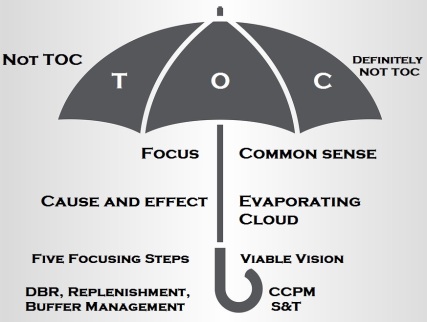
The Boundaries of TOC or What is “Not TOC”?

A colleague of mine, Alfonso Navarro, a TOC expert from Colombia, made the point that when people challenge a TOC methodology, offer substantial changes, or raise a new idea never discussed before, they get the response “This is not TOC!” Alfonso concern is that it forces people to keep their ideas and methods to themselves and refrain from sharing them.

Umbrella icon

Do we know what TOC is?

The main body of TOC is about managing human systems, which I prefer to call ‘organizations’.  I deal here only with TOC as an approach to managing organizations.  TOC, like any scientific area, is built from several key axioms. I recognize two critical axioms for TOC to be effective for managing organizations:

  1. The organization has a clear and well-agreed-upon one GOAL.
    • Usually with a set of necessary conditions that must apply, but when valid there is no desire to get more from those conditions.
    • For instance, maintaining good level of employee satisfaction and also client satisfaction and trust.
  2. The performance of the organization is NOT CHAOTIC.

The above axioms are not valid everywhere, but they are absolutely necessary for the TOC approach to be useful.  I have seen organizations, naturally not-for-profit, with critical disagreements between several powerful leaders about the goal and how to measure it.  Many universities live in constant internal struggle between different research fields and between research and teaching.  Many performing art institutions are in the same situation: struggle on what should be the goal and how it is measured.

When it is impossible to know whether the overall performance last year was better, worse, or about the same as the year before then I’m afraid TOC cannot help.

I treat an organization as chaotic when there is high uncertainty in the delivery to clients.  When an order might be delivered today, or only in three months and even that is not guaranteed then the organization is in chaos.  However, it seems that a chaotic organization is doomed to die pretty soon and I doubt whether TOC intervention can stop the fall.  Chaos in an organization is usually caused by several interactive constraints that suddenly emerge.  Most organizations naturally solve the chaotic situations quickly by adding capacity when the first signals of too much noise in the delivery are identified.  The others simply die.

When both axioms are valid then TOC can be applied.  The target is to lead to ongoing and significant improvement in the performance of the organization.

When an idea aiming at improving the performance is considered “not TOC”?

When TOC logical analysis, based on cause and effect using the categories of legitimate reservations (CLR), claims that either there are no benefits to the idea, meaning no evident improvement in performance, or that there are severe negative branches, which are likely to cause bigger overall damage, then the idea is flawed and one might call it “not TOC”. I prefer to point to the flaws of the idea, rather than describe it as non-TOC.

Checking the validity of cause and effect arguments is not hard science.  See my previous post on The Thinking Processes and Uncertainty.  We all use certain beliefs that we treat as truth, but there is no logical way to validate or invalidate them.  How can you treat a claim that if “one prays every morning” then “higher performance is achieved”?  I don’t like to deal with religion, it is just a reminder to the limitations of logic to give us full and secure judgment on the validity of an idea to improve performance.

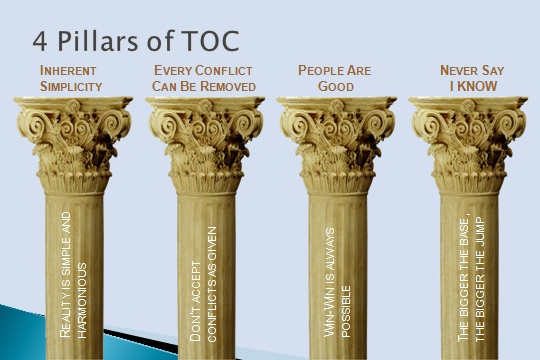
TOC has its own beliefs and observations that look as common sense that guide the TOC thinking and solutions.  The four pillars, presented by Goldratt, summarize the most important ones.

The four beliefs above are tied to basic philosophy that enables the TOC thinking and methods. However, the four pillars are not black-and-white orthodox beliefs.  Even if in a certain environment one of the beliefs is not fully valid then TOC is still applicable.

For instance, when I see an environment that does not look simple and harmonious, I should still try to look for the inherent simplicity, but not necessarily wait until I see it – I should do my best to come up with the best improvement I can think of.  The same goes for facing a conflict without realizing how to evaporate it. I’d realize my solution is limited, but it is the best at that time.

The belief that “People are good” requires an interpretation, because as a general belief I cannot accept it. However, as an initial guideline it is very beneficial.  The point is when we assume that people are good then we are able to outline their perspective and interests and then understand their actions.  So, when we see something we don’t like, this initial assumption guides us to understand.  Then we can better judge whether a specific person is good.

The statement “this is not TOC” is irrelevant to the judgment of any idea and it should not be used within the TOC community.  I don’t care whether the idea has been conceived using the TOC tools or guidelines.  Be aware that the current TOC tools do NOT guaranty inspiration! The TOC guidance might push us towards it, but we also might miss it.  As Goldratt said:  Never Say I Know!