

Indentifying the Emergence of Threats

word in the eye

Eli Goldratt spoke about the need to notice inconsistencies. He even claimed we need courage to do that. Once you realize the inconsistency you are urged to reconcile it even when it means updating one or more of your basic assumptions.

I’m not sure whether what we need is ‘courage’, because if we choose to ignore the inconsistency we expose ourselves to possible resulting threats of failing to understand our reality. What we need to do with ourselves is to acknowledge the fact that we don’t know, thus we make mistakes and we need to fix them in order never to repeat the same mistake.

When I learned programming I realized that the number of mistakes, bugs in software terminology, I had made were enormous. I had to accept the fact that I’m not all that clever to be able to do it right the first time. The good news were that every programmer generated many bugs, and thus the culture of software development was forced to recognize the existence of bugs and to expect every programmer to fix the bugs as soon as possible. I assume nowadays it is still the common culture in software, but only there. The frightening realization was that I probably do many mistakes in my “other life”, but do not have the computer to throw the mistakes in my face.

Failing to identify the threat is a mistake of ignoring signals that such a threat is developing.

It is our responsibility to identify emerging threats as early as possible and find the appropriate actions to neutralize the threats.

Some threats are anticipated before they emerge into our reality and put us, or our organization, into jeopardy. What we are able to do is to put a “control mechanism” in place. Here is my definition for the term ‘control’:

A reactive mechanism to handle uncertainty by monitoring information that points to a threatening situation and taking corrective actions accordingly

Buffer management, alarm systems, auditing of financial transactions, periodical medical checks and performance measurements are all control mechanisms for variety of potential threats that we take a-priori into consideration that they might emerge.

Sometimes a new threat is emerging, but with enough visibility so the identification is pretty much immediate. For instance, a proposed change in the tax laws, which might compromise our profits. Failing to note such a publicize threat signals an even bigger threat, because if such a clear threat is ignored, how many other emerging threats are ignored?

What can we do to identify the emergence of a new threat, of which we haven’t given a thought?

An emerging threat generates signals that are inconsistent with our expectations. We have a name for such a strange feeling that something unexpected has just happened. We call that feeling a SURPRISE.

Surprises can be good or bad, but the common effect is that every surprise points to a flawed paradigm that our brain uses automatically. A paradigm is actually a small cause and effect branch that we take automatically as true. For example:
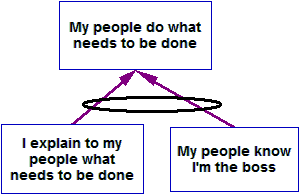
I explain to my people what needs to be done2

Does the above paradigm ALWAYS work? It does happen that my people do not do what needs to be done. This is a signal that there is a flaw in the logic. It is not clear, at that stage, what the flaw is.

The kernel of the signal is the gap between expectations and outcomes:

My expectations are: my people do exactly what I’ve asked them to do!

Now I face the following incident: I asked Dave to put in writing the full facts regarding Deal X. What I got is one page with just the most obvious facts and many of the important happenings are missing.

I’m angry with Dave. This is not what I have expected from him. What should I do?

We usually deal with the gap between what we want and what we get. Organizations often check the gap between the plan and the execution. I point to the gap of realistic expectations and actual outcomes as a key opportunity to update a flawed paradigm.

Let’s look again at the simple case of Dave giving too short report on Deal X. The gap signals a flawed paradigm, but what is it? I did explain what to do and I’m still the boss.

Three (should be more) initial possible explanations:

  • Dave did not care what I’ve asked him to do
  • Dave was too busy with many other things he had to do
  • Dave did not understand the required level of details

To understand what truly went wrong in the case, there is a need to validate the facts and then dive into the paradigms we, both me and Dave, operate at.

Without carrying here the full analysis, let’s imagine the following realization is revealed:

When I do not clearly explain the “what for?” question of what I ask to do, it is possible that the outcome would not be what I think it should be.

If this is a new learned lesson – can you see the scope of the positive consequences? The possibility that their instructions would not be followed is a threat to every manager. If they do internalize the need to explain why it is necessary to do this-and-that then big part of that threat would not materialized. However, a similar gap might still emerge as a result of other flawed paradigms. We should still be open to spot surprises and go ahead with the learning process.

Clarifying the Concept of Throughput

Throughput (T) is a central concept in TOC and it should be a central concept for all management. I see it as expressing the added-value created by the organization. I focus on the value of using T, I and OE for making superior decisions.

The formal definition of T for profit organization is: Revenues minus the truly-variable-costs (TVC).

Don't forget the cost of the water when predicting the T
Don’t forget the cost of the water when calculating the T

We use T as a periodical performance measurement and use it also for judging the economic impact of a single decision – the delta-T generated by the decision minus the delta-OE (operating expenses) caused by the decision at hand.

The revenue part of the definition of T is relatively straight-forward. The definition is still open whether one should consider the timing of receiving the revenues. Is T of $1,000 to be received next year the same as T of $1,000 today? This is quite a topic to deal with at another time.

An even more relevant issue is the impact of uncertainty on the revenues. As decisions always aim at the future, the prediction that we’d generate revenues is always based on forecasting.

On top of how to predict the revenues there is another issue: what should be included in the TVC? Eli Goldratt added the term “truly” to the “variable cost” to warn us to be careful about what we regard as TVC.

I like to highlight two important problematic areas with TVC.

One: are the costs of raw-materials always TVC?

Two: high level decisions might include costs that do not vary with smaller decisions. Should we treat those as TVC?

Why do we claim that raw materials are truly-variable-costs?

Purchasing raw materials is usually done long before firm orders for the end-product are received. It means that the cost has been spent no matter whether we have sold or not. Thus, the cost is not directly triggered by the sale! So, why do we usually consider the material cost as part of the T and not part of the operating expenses (OE)?

When raw materials are regularly replenished we can safely assume that any sale of end-products initiates purchasing of materials.

In such a case it is right to treat the cost of raw materials as TVC as we are used to do.

This observation means that when a decision to stop further production of specific items has been made then the subsequent sales of that product should not treat the cost of materials as TVC. It is a mistake to refrain from selling items, whose production is stopped, because the market price is lower than the cost of materials. The only two relevant questions are whether we have enough available capacity, which cannot be used for existing demand, and whether selling old products for reduced price would cause loss of sales of full-price items or reduced the image of the brand in the market.

Suppose you hear that the cost of materials went up by 20%. Fortunately you still have enough inventory of the materials for the next two months. When would you update the TVC, causing significant reduction of your T per product-unit?

My view is that the T should be updated immediately!  Remember the assumption: any sale triggers replenishment of the materials. This is the basic assumption behind including the material cost in the TVC.

The other case to consider is the variable costs of a high level decision. Example: The TVC of adding a passenger on a flight is pretty low, mainly the impact of the additional weight on the fuel consumption. However, when a decision to cancel, or add, a flight is considered we are exposed to very different level of variable costs. The fuel consumption of the whole trip is definitely a significant variable cost item. The cost of the crew include variable elements that depend on actual hours of flight and the stay in a far away city. I claim that even the maintenance costs of a flight have to be considered TVC, because those costs are mandatory for X hours of flights, thus any cancelation of flight reduces the relative future cost of maintenance.

However, should those “higher level TVC” be part of the T?

I suggest calling TVC only the truly-variable-costs of a SINGLE SALE! For such a sale we have a clear definition of throughput and any high level decision, like adding or cancelling a flight, would anyway involve certain delta-OE, which considers all the expenses caused by the decision. Thus, the decision criteria of delta-T – delta(OE) > 0, is still intact.

Readers who happen to live in Europe and look to understand the potential of throughput accounting for their business, and to be exposed to wide expansion of the power of T, I and OE, should be aware of my session in Paris in October. Have a look at: http://www.marris-consulting.com/en/Formation-Throughput-Accounting-253.html

Defining the Market Segment – a neglected critical issue

Eli Goldratt said: Segment the market – don’t segment your resources!

Goldratt wished to allow as much as possible market segmentation in order to price differently the same basic products, produced and delivered by the same group of resources. In order to do so successfully we need to understand every market segment very well and include in the package of product features and the service around it unique value for that particular segment. Airlines are great in exploiting the possibilities for different prices; from how long before the flight you purchase the ticket, through the different classes, whether you are allowed to change your flight and even when you like to sit in an exit row.

Analysis Target

I claim that the concept of a decisive competitive edge (DCE) forces us to look again and in depth into the definition of the segment to which the DCE is most valuable. So, once we have a DCE in mind we should be able to conclude who are going to get the most value – and that group is the market segment we are looking for. For instance, offering superior inventory-turns as a DCE is attractive to clients that have all these characteristics:

  • The client uses inventory-turns as a formal measurement.
  • We are responsible to significant amount of the client’s inventory, at least the inventory for which the decision maker we do business with is responsible for.  Thus, we are able, using our logistics, to make a real impact on our client’s relevant inventory turns.
  • We are considered by the client as a good supplier.
    • While this characteristic depends a lot on us, we need to recognize that when this is not the case it’d be very difficult to change the perception of the client.  Thus, we need to exclude from the segment definition clients who don’t trust us.
    • This condition usually considers old clients.  New clients might belong to the segment when we know they have heard good things about our company and products.
  • The responsible person at the client is open enough to let’s manage our SKUs at his site.

We might think of another segment, which might still get a lot of value, like when inventory turns are not used as a formal measurement, but the client struggles with their cash, or suffers a lot of from shortages. However, the selling process would be quite different, certainly without the emphasis on inventory-turns.

My conclusions are that defining well the market segment(s) is absolutely critical to the choice of the DCE, and thus has a huge impact on the Strategy.

How do we analyze our clients to construct the segment definition?

I have often encountered the idea of constructing the CRT of our potential clients or the CRT of the whole market. I don’t really like the idea because of two points. First, I believe it is impossible to construct a CRT without the active participation of the organization. I’m also not sure whether the whole market has the same one core problem. Second, even if we succeed to identify the core problem then what is the probability that we are able to solve (evaporate the cloud) the core problem for our potential clients?

What we can do is identify several key UDEs that our clients are aware of, which we could eliminate or reduce. Please, note the difference. We don’t try to connect all client UDEs. We just contribute value by reducing the negative impact of one or few UDEs. For our clients this is usually enough to prefer us on our competitors and by this gain a decisive competitive edge.

How do we identify UDEs of our clients that we might be able to solve?

By considering the environment of the client and taking into account some of the common flawed paradigms, we are able to speculate several possible negative results, which are the UDEs we look for.

For instance, batching the transportation leads to overstock and shortages at the same time. When we speculate such an effect it is not difficult to validate that this is really the case. Offering low stock and very rare shortages hit directly at the pain, without having to fight with the paradigm of batching as a saving cost mechanism.

As a consultant to various types of organizations I’m amazed how little consideration to proper market segmentation analysis is given. The core cause is probably the naïve belief that “our products are good for everyone.” Most small to medium size organizations do not have active marketing people. Larger organizations have marketing efforts that are mostly advertising. The key messages in advertising campaigns consider very gross definition of the target market, like “young people between 16 and 24”, but that’s it. I have not seen many clear definitions of the market segment per SKU category. In cosmetics you just find a little bit more awareness to specific segments. We should, as part of our TOC background, demand clearer analysis of the potential customers who would draw the most value of specific products. Certainly we need a clear definition of the segment for which our DCE is target to.

A small example to discuss. Currently I use Windows 8 on my desktop computer. I get messages like “Your Free Upgrade to Windows 10”. It is nice to get value for free – BUT WHAT IS THE VALUE? Microsoft does not tell me. I don’t know whether the unique value is directed at software developers, people who practically spend their life in front of the PC, or elderly people who still use computers? Microsoft does not tell. Maybe they never thought about it. I do claim they should have. Even an operating system cannot yield a lot of value to everybody.

Analyzing the case: Removing the Obstacles from my Promotions

I got answers to the case from just three people, fortunately each of the answers offered something valuable to consider and discuss.  Is the relatively low response due to the personal side of the case and that does not seem like TOC?  Or, the natural wish to be promoted is not considered legitimate when one is brought to focus on achieving the goal of the organization?  I have learned from Dr. Goldratt not to expect other people to be “angels”, meaning acting against their personal interests.  This insight is not in clash with Goldratt basic assumption that “people are good”.  People, according to Goldratt, do not wish to cause harm – unless they have a reason, like an interest of their own or a faulty assumption.

In a previous post I’ve claimed that a person with an ambition for his/her future should plan a Strategy outlining what the person needs to do in order to achieve the “dream”.  Claudio certainly has a dream and becoming an SVP is probably not the full dream, but it is an intermediate objective.  I believe Claudio likes to lead CompAdvantage to be bigger and more profitable, while keeping it stable, very much like he has led his region.

I first wanted to demonstrate that failing to consider a-priory the views of key people could become an obstacle.  I assume that Claudio was aware of the criticism regarding his managerial style, but ignored it as he was quite successful in establishing the region as the most profitable in the company.  Now, these views become real obstacle.

Michael Bolanos has expressed Claudio’s situation very clear: “Claudio’s challenge cannot be overcome by changing his personality and management style overnight. Claudio needs to enforce that his style and leadership are needed for capitalizing on the opportunities from Eastern Europe and North America in a not too distant horizon.”

In other words, Michael claims that Claudio has to radiate his own decisive competitive edge (DCE), based on his style and leadership, which have achieved excellent results in Latin America, and claim that this is what is required for the other regions as well.

However, his main rival, Martha, excels in another DCE: being able to initiate new moves that result in considerable fast growth.  Such behavior is much more risky and could also cause considerable instability.

The conflict between stability and growth is at the heart of the choice between the two major candidates.  Dale, the CEO, probably prefers stability, and thus supports Claudio.  Knowledge of TOC, as well as preparing and improving his own DCE, could have led Claudio to construct an ambitious M&S plan that is based on a strong DCE of CompAdvantage.  However we don’t know what is the potential DCE of CompAdvantage and it seems Claudio did not prepare his Strategy early enough.  What he did well, which is critical to get the approval of the SVPs, was his support to Latin America Operations.  This support shows Claudio’s ability to cooperate with colleagues and to understand the big picture.  That ability should be emphasized in the internal conversations Claudio has to make with the SVPs.

One potential critical obstacle for Claudio is the nomination of his successor.  Let me cite from David’s answer: “As alluded to by Utkan, succession planning would also be important. A question that the SVPs would have is: who will take over from the candidate? Claudio needs to have a good answer. It might also encourage his underlings to express their support for his promotion and speak well of him.”

As a tyrant it makes sense to assume that Claudio did NOT prepare his successor.  This might be looked as a serious problem to the SVPs.  Raising a worthy person to take over the most profitable region is a test in stability for Claudio.  He has two months to pick the right person and openly announce him as worthy for taking over from him.

Michael Bolanos also noted the sensitivity of replacing Claudio.  It is a part of Michael’s bold suggestion for Claudio to publicly support the nomination of Avraham.  It is an idea with a twist – doing what nobody else expects him to.  I have to admit it is a too big twist for me too.  I don’t think I’d take the risk, were it me instead of Claudio, but it is certainly a refreshing idea that needs to be considered, along its self-evident risk.

The TOC Key Decisions Support (DSTOC)

I’m aware of the old Jewish wisdom that a person cannot testify to his/her own creations. But, somehow I feel compelled to attract enough curiosity, so busy people would find the time to come, listen, experience and argue on a topic that is, according to my own judgment, critical to almost all businesses.

Have a look at: http://tinyurl.com/p25dtat

EliS workshop3

Three critical organizational decision areas deserve to get special considerations:

  1. What to sell?

The answer to the question is not just the broad definition of what the organization offers the clients. The answer includes many frequent decisions about the variety of the offerings and the services around it and even the relative priority of trying to sell more of specific products or services. There should be ongoing efforts to define the overall product-mix that maximizes the profit (or another goal) and that mix constantly changes according to the demand and the capacity situations.

  1. What price is good for large enough potential customers as well as for the organization?
  2. How much available capacity, including manpower, should the organization maintain?

The investment in available capacity dictates what the organization is able to deliver in the near future. Changing the capacity levels are “hard decisions”, meaning the decisions are made under high uncertainty, and the decision maker might find himself under harsh criticism if the future demand does not justify the investment.

TOC has started its way with sharp criticism on the common tools of management accounting to support the above decisions. In spite of some progress, the common management accounting tools are still basically flawed. Even the TOC tools and knowledge need a certain update and wider scope, to be able to deal effectively with the three key decisions above.

I have already expressed in my blog the faulty assumption of management accounting:

Assuming the cost of capacity is linear.

I have also briefly shown the direction of the solution, which is considerbaly wider than the current throughput accounting tools.

However, understanding the full solution requires more experience with examples and hands-on use of the supporting software. Without that extra in-depth understanding there is a risk of cutting corners in a bad way.

Blogs, webinars and presentations can do a lot, but eventually face-to-face learning has some additional powerful characteristics that complement the above tools.

I’m going to deliver a two-day workshop on that topic. It is going to be in Paris, October 15-16. The above link contains detailed information. If you are interested enough to read my blog then I believe you are going to gain added value from participation, value that I still find hard to deliver in alternative ways.

Removing the Obstacles for my Promotion

A riddle/fictional case for discussion, fun and learning

Last post dealt with personal Strategy – this case strongly relates to it!

Cloud services with cloud and ladder

Dale, the CEO of CompAdvantage told Claudio that he is his chosen candidate for Senior VP of Global Marketing and Sales. Fritz, the current SVP of Global M&S, is retiring in three months, and all the ‘C’ level executives of CompAdvantage are meeting in two months to recommend the board of directors of Fritz’ replacement. Fritz shows considerable appreciation for Claudio, but has also expressed reservations from Claudio referring all the achievements of his division to himself. Claudio suspects that Fritz is going to recommend Martha for the job. Martha has won a lot of credit lately due to her success in entering the Eastern Europe market in the last three years, which reduces Martha’s failure in advocating the long legal fight with its biggest competitor PeachSales, which ended in total disaster and huge cost.

Claudio has been the VP of Marketing and Sales of Latin America in the last five years. Latin America is still the most profitable market of CompAdvantage, but two other large markets are steadily growing: Eastern Europe, led by Martha, and North America led by Abraham. Both Martha and Avraham are Claudio’s rivals for the desired position. An interesting point is that Abraham had mentored Martha for three years as his deputy. However, Abraham is now over 62 years old, so he is less likely to get the job – unless he is considered as a compromise between Claudio and Martha. The possibility of a compromise is a threat that Claudio is trying to prevent. But, how can he reduce the probability of this option to happen?

Claudio has put a list of all the senior VPs that would participate in the crucial meeting. He noted those that he is pretty sure would back his candidacy, including Brad, now the SVP of Global Logistic whom Claudio closely supported when he has been in charge of Latin America’s operations. Linda, the SVP of Global Design Development would probably back him as well, as her relationships with Martha are not good and she has openly criticized Martha as a reckless manager. On the other hand, Henry, the SVP of all subsidiaries of CompAdvantage would surely support Martha. Anyway, there are still six additional SVPs that Claudio is not certain about their preferences.

“Question is,” thought Claudio, “what can I do now to strengthen my position? And what can I do to reduce the impact of the opposing arguments against me?”

Within the huge organization of CompAdvantage it is well known that Claudio is a tyrant. All his managers are in constant fear of him being unsatisfied with their achievements. Some of the other VPs appreciate this style of managing, assuming it is the effective way to motivate the lower level managers to work harder. Others claim that such a style limits the subordinate managers’ to take their own initiatives and develop their managerial skills.

Fact is: Claudio has led his vast region very successfully and this success is significantly expressed in the global financial state of CompAdvantage.

Question 1: If you were a senior vice-president, striving for the future success of CompAdvantage, what should be a decisive criterion in preferring one of the three candidates?

Question 2: What could Claudio do in the short term to improve his chance?

Developing our Own Personal Decisive Competitive Edge

I claim that while organizations have to have ONE clear goal, bounded by several values or necessary conditions, humans may have more than one goal for their life.

The most critical personal conflict is between enjoying the moment and building the future. This is an ongoing conflict from the time we make decisions for ourselves until our death. The realization we are going to die contributes to the conflict, because if we won’t enjoy NOW it is not clear whether we’ll enjoy at all.

Once we decide to build a family a new dimension is added to the conflict: enjoy now, do for your family and do for your future. It is a three dimensional cloud!

The essence of “doing for our future” changes with age. At first the main objective is to establish good and long life of happiness. Then it slowly changes to the wish to leave something valuable after death. Children are a key in this respect, but also the wish to create value that would remain for very long time and keep us alive in the memory of others. Artists and politicians strive to achieve that feeling of immortality.

A way to evaporate the conflict is to enjoy now from what I do for my future. It could mean enjoy studying in school or enjoy working for our future career. Sometimes, but definitely not always, this enjoyment is real. But, even when we do really enjoy doing things for our future it evaporates only part of the conflict as we always have to do some things we definitely dislike. For instance, taking an exam or change the diapers of our baby.

One Businessman With Lighting Bulb Head Standing Opposite To Gro

In developing our future we gain capabilities that we hope would create something unique. Looking into the value we’d give to others in a way others are not able to. Being a devoted parent you strive to give value to your child that would be sustained throughout his or her life. If you work hard to develop a new business you like to give your future clients unique value. When you wish to be promoted you better strive to do something that would make a positive change to the organization you work for.

This is very similar to gaining a decisive competitive edge for an organization. It is a human need to be recognized as unique in a certain area for a specific group of people. The person has to differentiate himself from “competitors” by adding value the competitors are unable to. More, the person needs to be recognized as having the unique qualities that bring the extra value.

This means every person with a certain ambition for his future would do better if he/she develops a Strategy for what is required to achieve that goal.

This is what Goldratt called to live full and meaningful life. I have seen him many times asking young people what is their “dream” for the future, and immediately continue by asking them what they do to accomplish their dream.  It was amazing to me to realize that too many young people expressed their dream, but it did not occur to them to plan what they need to do to materialize that dream.

The plan has to include the ONE key personal advantage that would generate unique value to the relevant people. The other parts of the personal Strategy should be how to handle the other dimensions of the personal life and how to radiate to others the personal qualities to convince them to collaborate. Remember that when you convince others you need to address the value for them to gain.

What do you think makes YOU special?

What do you do when something that should not have happened – has happened?

A real story from the Holy Land

four weeks ago the annual parade of the homosexual community took place in Jerusalem. The police dedicated a lot of manpower to make sure no violence would take place. But, in spite of all the security measures an ultra-orthodox male attacked as many people he could. A sixteen years old girl was murdered and five wounded. When that person was taken into custody – it was revealed that ten years ago he attacked the same parade and wounded several people, a crime for which he was sentenced to ten years in prison. He was released just two weeks prior to the incident.

incident1

This murder should not have happened. There was prior knowledge, even expectations, that such a person might do it again.

The automatic reaction to the incident was carrying an inquiry to find those who were responsible for the terrible event. The existing common culture in Israeli politics is demanding the layoff of the responsible parties who have failed to do their job. The tragic consequences made the failing much more severe. This means, failing to do your job is bad enough, causing tragic consequences, even though you did not have any influence on the consequences, is TERRIBLE and you have to pay the price.

Let me stress the last point as it is part of the general ignorance to deal with uncertainty. If the attacker would have been stopped before wounding anyone – no inquiry and no public punishments would have occurred. So, the paradigm is that when you make a mistake you are responsible for the consequences of the mistake. This is true even though the actual consequences depend solely on luck (or God).

Part of the cultural problem is the participation of the media in the vocal public demand to remove senior figures from their job in order to feel that “justice has been done”. The smell of blood is of great value to the media.

Does the automatic reaction reduce the probability for future mistakes???

To my mind: definitely NOT. There are three causes for failing to prevent similar mistakes in the future:

    • We often don’t really understand the core cause of problem that caused the undesired effect.  An inquiry that aims to find guilt, rather than solution, frightens people causing them to conceal facts that might point to them!
    • Even when the full facts are revealed – the real issue of “how come good and experienced people have made the mistakes that caused the chain of effects” is not fully recognized. The real lessons are not learned and digested and thus no real change takes place.
    • Sometimes people who made a mistake intuitively understand what went wrong and why.  Now, if you replace those people with people who did not experience such a mistakewhat is the chance that they would not repeat a similar mistake???

I have developed, together with Dr. Avner Passal, who is an organizational behavior consultant, a methodology for Learning from ONE Event (called also learning from Experience). There is a past webinar on the TOCICO site and everyone who just likes to get the slides could write to elischragenheim@gmail.com).

However, the necessary condition for truly learning the RIGHT LESSONS from an unfortunate event is not to prosecute people for their mistakes, but demanding that mistakes should not be repeated!

There are three different cases where we should take actions against people who made major mistakes:

  1. They showed clear and significant negligence!
  2. They made a clear unprofessional mistake!  For this to apply you have to be quite certain that any other qualified person would NOT have done that mistake.
  3. There was intent to cause damage!  I believe this is a very rare incident, and when it happens I’d initiate an inquiry to understand and learn the lessons how come somebody wanted to cause such damage.

When the right culture is in place, recognizing that we all make mistakes and when we do such a mistake we are required to learn the right lessons for the future. Implementing the structured methodology would generate real value.

The ability to analyze an unfortunate event (it can also deal with unexpected fortunate events), diagnosing the core flawed paradigm and carefully develop the ramifications, should be viewed as an integral part of TOC Culture leading to ever-flourishing organizations.

“To Change or not to Change” – Developing a Long Line of Thoughts

Is it a good idea to fight with already made expectations?

The happy women shopping in a supermarket

Private-labels are known for offering low price. Charging private-label items higher than the regular price is counter-intuitive and risky. With very limited space and parking the current market-segment GoodChoice is facing contains many customers for whom the cheaper prices of GoodChoice are critical. The limitations force GoodChoice to offer limited variety of well-fit choice of end-items. Every single item needs to be of good enough quality because many customers cannot afford wasting money on “experiments”. Launching an expensive private-label looks to me the wrong idea for such a case. Not every differentiation works well.

Emphasizing the commitment to sell only worthy products as private-label is good and necessary. It allows selling the private-label products with relatively small price reduction. Question is how to give the commitment to quality enough credibility. After all it is so easy to tell customers that every item has been carefully tested and proven to be great. Would YOU believe such a statement from the store management?

In his comment to the case Rajeev Athavale wrote that when an unidentified supplier is producing the item, keeping stable high quality is difficult. I agree with most of Rajeev’s analysis, but not on this point. GoodChoice as a client of a supplier is able to supervise the quality of the products it gets and certainly returns from customers could be used to threaten the producer to maintain excellent quality.

Would a policy to return even open packages cause too many refunds?

I doubt whether many people would consistently demand their money back, but it is an issue to be checked. If every refund is registered and the customer has to sign a declaration of dissatisfaction from the item, then a customer returning the same product twice will have a lot to explain.

So, the recommended step for GoodChoice is to go on with the introduction of its private-label, but price it moderately below the regular price of the leading brand, and to add a commitment for quality, which is backed by open return policy.

Can GoodChoice do more?

Actually GoodChoice likes to provide good quality of all its products.

It is certainly important to know which products disappoint the customers and which are truly welcome. The regular way to control the worthiness of products is to closely watch the sales trend. But, the fast pace of new products introduction, and the frequency of promotions, makes the analysis too slow for good active reaction to the market.

How can such a supermarket chain get fast and reliable feedback from its customers?

Complaints and returns are one way to identify the unsatisfactory products (also flawed processes). However customers do not like to answer long questionnaires and they do not always reflect what they truly think.

Here is an idea I’ve recently learned from British Airways. I was giving a “Golden Ticket”, recognizing excellent service, which I could give to a British Airline employee who gave me excellent service.

I like to suggest “translating” the idea for GoodChoice, actually to any supermarket longing to know more about how customers like, or dislike, certain products.

Issue a Golden Product Ticket and a Red Product Ticket. Every client stepping in should get one gold ticket and one red. The client could write the full name of just one product in each ticket. The gold ticket means excellent product and the red means bad product. The customers who like to fill in the ticket put it in a box at the cashier stand where they pay.

What do you think? Would this kind of fast feedback work well?

To Change or not to Change?

A case about a strategic dilemma

Following the topic of The Key Element of Any Strategy I like to present a case for discussing the basic conflict when we consider a significant change. Please, send me your answers and analysis.

a woman shopping in a grocery store

GoodChoice is a chain of small supermarkets throughout the Large-City. It was initiated by Marcello when he inherited the GoodChoice bakery his father built from scratch. Today, ten years later, the overall worth of Goodchoice Chain, including the bakery, which sells its variety of breads through the supermarket chain, is dozen times larger than the business of Marcello’s father.

Should Marcello be proud of his achievements?

He certainly likes to continue to grow. The hard competition with the other three supermarket chains, all of which are larger than GoodChoice, forces relatively low overall profitability of just 1.4% of the sales. The battle with the competitors is on every promotion and on every supplier, causing Goodchoice to pay higher prices to suppliers, while charging the customers lower prices than the competitors.

The marketing message that GoodChoice tries hard to spread is that they choose the items sold in any branch very carefully and guaranty high quality. Every GoodChoice branch holds between 1,500 – 2,200 SKUs. The GoodChoice branches are all located within the city itself, and thus have very limited space and limited parking. A typical branch of the competitors, usually located at the outer parts of the city, where parking is not a problem, carries between 4,000 to 12,000 SKUs.

All three competitors have their own private-labels, covering wide-range of items, with average price of 15% less than the price of the leader brand. Marcello already started his negotiations with various suppliers to establish the GoodChoice private-label. However, he likes to do something quite different and charge HIGHER price, of about 4%, for the private-label!

Marcello also wants to emphasis the message that GoodChoice gives to its customers absolute guaranty on the quality of the private-label products. He thinks of letting customers return even open packages if they claim they don’t like it. This idea invokes many negative reactions from Marcello’s team as they are concerned that too many customers will cheat to get refunds.

What do you think? Should GoodChoice make the change with their new private-label, charge more for an exceptionally strong guaranty policy? Or, follow the norm in the specific business area?